


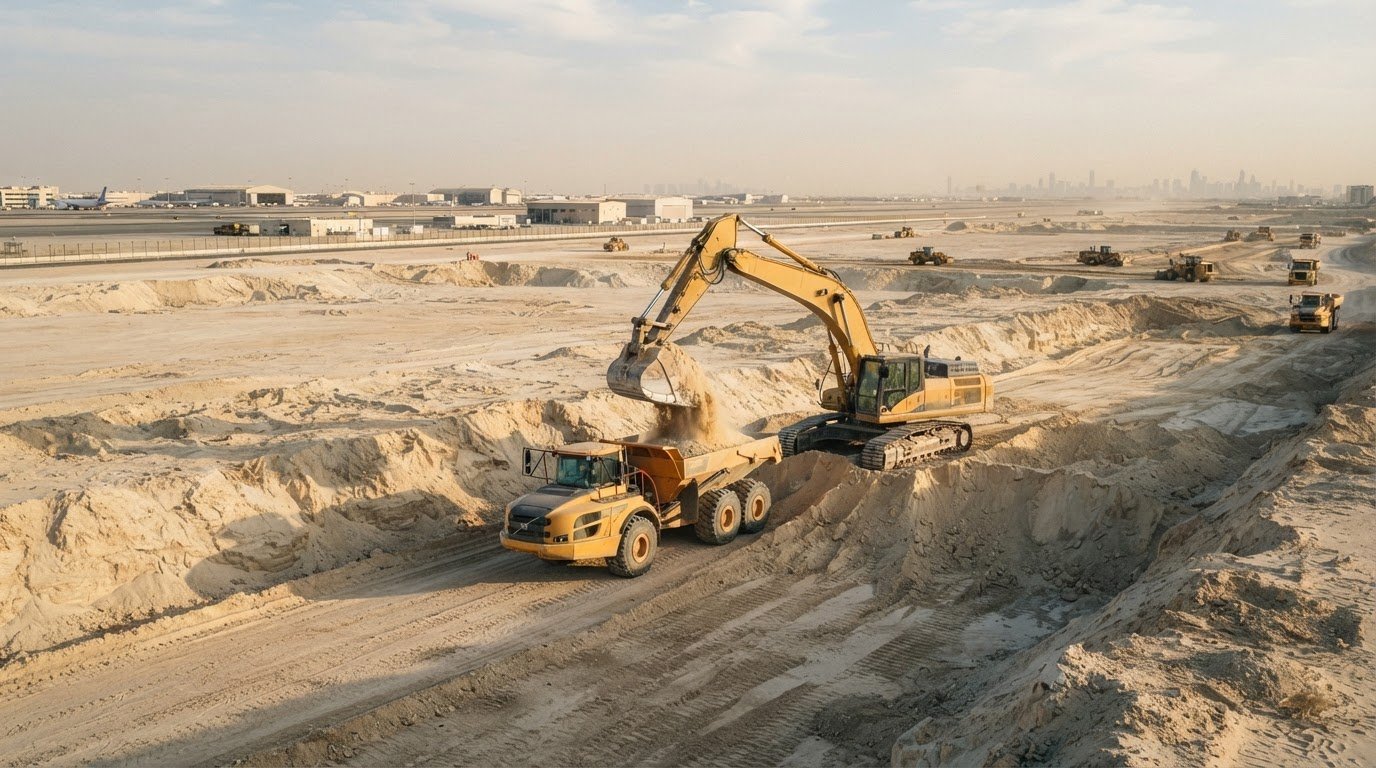
The development project remains on track for commencement of operations in 2032: Al Maktoum International Airport’s first operational phase is planned to begin that year, with capacity for approximately 150 million passengers per year. This is the opening milestone, not the end of the airport’s wider transition.
A 2032 start is a significant marker, but the schedule is part of a longer process: the staged transfer of every flight from Dubai International is scheduled to run through 2035. Construction progress offers further context, from excavation works exceeding 45 million cubic metres to a workforce expected to grow from around 9,000 people to approximately 120,000 at peak construction.
This update explains how those construction and workforce indicators relate to the Phase 1 timeline, what the planned opening means for the airport’s development, and how to assess its potential relevance to long-term real estate decisions in Dubai. The focus is on the project’s stated milestones and the distinction between an initial operations start and the broader transition ahead.
Key Takeaways
- Separate the airport’s initial operating milestone from the longer transition of flights, and use that distinction when assessing the timeline.
- Understand how construction activity and workforce growth offer context for the project’s progress without treating them as a guarantee of completion.
- Locate the development in Dubai and consider how its position may shape the way you assess nearby areas and long-term property decisions.
- Explore how the airport’s purpose and planned capacity could inform your view of Dubai houses, villas, townhouses and commercial properties.
Construction progress and workforce
Al Maktoum International Airport’s first operational phase is planned to begin in 2032. Construction activity provides context for that target, but excavation, structures, engineering packages and workforce mobilisation must progress together before passenger operations can start.
Excavation works have exceeded 45 million cubic metres, while more than 17,000 concrete piles have been installed. Core infrastructure packages include approximately 4.5 million cubic metres of concrete works. Construction teams logged more than 10 million work hours over the course of 15 months, showing the scale of execution across the site.
The on-site workforce is currently around 9,000 people and is expected to reach approximately 120,000 workers at peak construction. That growth reflects the project’s changing requirements as separate construction packages advance. Workforce expansion is one indicator of activity, not by itself proof that every element will be ready for 2032 operations.
Dubai Aviation Engineering Projects is preparing further airport contract awards. These figures cover awarded, ongoing and planned packages, not a single total project valuation.
For a useful comparison with similar regional developments, consider scope and delivery stage: runway and terminal requirements, construction packages, workforce mobilisation and the operations milestone. The available figures do not support ranking this project against another airport.
Approvals and permits relate to the project’s aviation, engineering and construction workstreams. The figures above describe physical progress and contract activity, but do not identify specific approvals or regulations.
Dubai Aviation Engineering Projects is the named body preparing further contract awards; the available project details do not identify the full funding structure or airport operator. Potential schedule risks include delays across interdependent construction packages, workforce mobilisation or readiness of essential infrastructure, any of which could affect the 2032 commencement target.
Locally, the workforce scale points to substantial construction employment, while airport infrastructure may support wider business activity. These are potential benefits; the project figures do not quantify local economic or community outcomes.
Phase 1 operations timeline
Al Maktoum International’s first operational phase is planned to begin in 2032. The development project remains on track for commencement of operations in 2032 as its stated target, while the complete transition from Dubai International is scheduled to continue through 2035. These dates describe separate stages: an initial airport opening, followed by a longer transfer of flights across Dubai’s aviation network.
For passengers, a phased opening means the new airport is not expected to take over every Dubai International service at once. The transfer schedule allows operations to move over time, rather than treating 2032 as the date when all aircraft and services relocate. Its progress depends on construction, operational infrastructure and logistics aligning with each stage of the transition.
Phase 1 is planned for capacity of approximately 150 million passengers per year. This describes the scale the first operational phase is designed to support, not an expectation that passenger numbers will reach that level immediately. The distinction helps clarify the 2032 milestone: it is the planned start of initial operations, not the point when the full masterplan is complete.
Construction completion alone does not make an airport operational. Facilities and systems required for passenger processing, aircraft movement and baggage handling must work together. For readers assessing whether the development project remains on track for commencement of operations in 2032, the relevant distinction is between visible construction progress and readiness for operations.
As the programme advances, useful timeline indicators include progress on major construction packages, readiness of essential infrastructure and the staged transfer from Dubai International. Runway availability and airport systems also matter to an operational opening. Keeping the Phase 1 start separate from the later transition provides a clearer way to interpret updates about the airport’s schedule.
Where is the development project located?
Al Maktoum International Airport is located in Dubai, United Arab Emirates. Its planned site covers about 70 km², giving the development a substantial footprint within the emirate. That scale helps explain why the project is more than a passenger terminal expansion: its masterplan brings airfield infrastructure and airport facilities together across a large, coordinated site.
The planned layout includes seven concourses and two passenger terminals when fully completed. These components are part of the airport’s wider design, rather than a description of everything that will open during Phase 1. For location analysis, that distinction matters: the site’s full masterplan extends beyond the facilities associated with its first operational stage.
Runway details also give a practical sense of the airport’s physical scale. The airport’s runways form part of its wider airfield infrastructure. The second runway has been completed in preparation for rehabilitation of the existing runway. Together, these features show how the airfield forms a major part of the development’s land requirements.
A 70 km² site should be considered as an integrated airport district, not simply as a single building address. The runway system, terminals and concourses occupy distinct roles within the masterplan, so proximity to one facility does not necessarily describe access to the wider airport. The site’s layout and the phase of development are important context for understanding future connections and surrounding land use.
For property decisions in Dubai, the airport’s location is one factor to assess alongside access routes, nearby services and the specific area under consideration. The published project facts establish the airport’s position in Dubai and its planned footprint, but they do not establish travel times or the effect on individual neighbourhoods. A sound comparison therefore starts with the exact property location, then considers its relationship to the relevant airport facilities and the project’s development stage.
What is the project’s purpose and planned capacity?
Al Maktoum International is planned as a major aviation hub serving passenger travel and air cargo. Its full masterplan describes an airport designed for substantial passenger and freight operations. Both functions matter: passenger facilities support travellers, while cargo capacity serves logistics activity. The figures describe the completed plan, not the capacity available at initial opening.
When fully completed, the airport is designed to accommodate more than 260 million passengers annually. This is a planned annual capacity, not a forecast that this passenger volume will be reached immediately. For context, the first operational phase has a separate capacity plan. Keeping the phase figure distinct from the eventual masterplan helps explain how the airport’s role is expected to develop over time.
Cargo is another core part of the design. Al Maktoum International is planned to handle up to 12 million tonnes of cargo each year when fully completed. That planned freight capacity places logistics alongside passenger aviation in the project’s purpose. It also means the airport’s intended function extends beyond moving travellers, although the figure alone does not show how cargo volumes will grow.
The completed masterplan includes five parallel runways capable of operating independently, alongside more than 430 aircraft gates and stands. Those components indicate the scale of airfield and aircraft-handling infrastructure envisioned. They are full-completion features, rather than a description of facilities all available at Phase 1. The distinction is useful when interpreting announcements about opening milestones and long-term capacity.
For Dubai, the project’s planned capacity provides context for considering how aviation and logistics infrastructure may evolve. It does not, by itself, establish a particular outcome for property values or demand. A measured property assessment should consider the specific location, access and relevant development stage alongside airport plans. To place infrastructure ambitions in a wider market context, explore Dubai property investment considerations.
Chainex Real Estate
Chainex Real Estate helps readers connect Dubai’s airport development plans with considered property decisions. If you’re weighing how the project’s location, phased timeline and planned capacity relate to your priorities, the team can help you explore relevant areas and property options across the UAE. Its offerings include houses for sale, villas, townhouses and commercial properties throughout the Emirates, supporting different residential and business objectives.
Turn to Chainex Real Estate when you’re ready to assess available properties in the context of your plans, rather than treating the 2032 milestone as a prediction of individual market outcomes. For a measured discussion of your requirements, contact Chainex Real Estate.
Make your next property decision with perspective
With the development project remaining on track for commencement of operations in 2032, the most useful next step is to clarify what you want a property decision to achieve. Consider how location, intended use and your own time horizon fit together, rather than treating a major infrastructure milestone as a standalone signal. That perspective can help keep your decision grounded in your needs as plans for the surrounding area evolve.
Individual property outcomes depend on the specific location and circumstances, so a careful discussion can help you weigh relevant options without relying on assumptions. Chainex Real Estate can support your search with a focused view of Dubai’s property market and the options that suit your priorities.
Contact Chainex Real Estate today to discuss your next step. A well-considered decision starts with the right questions and a clear view of what matters to you.
Frequently Asked Questions
Which development project is expected to commence operations in 2032?
Al Maktoum International Airport in Dubai is the project planned to begin its first operational phase in 2032. This refers to the airport’s initial opening, not the completion of the full masterplan. For readers assessing the development’s wider significance, it helps to distinguish the airport’s first operating stage from its long-term build-out and the wider transition of flights across Dubai’s aviation network.
What is the project’s current development status and schedule?
The project is in active construction, with excavation, concrete works, installed piles and contract packages forming part of the progress to date. The schedule identifies 2032 as the planned start of Phase 1 operations, while the staged transfer of flights from Dubai International is scheduled to continue through 2035. These are related but separate milestones, so the opening date does not mark the end of the transition.
What are the key milestones leading to operations in 2032?
Key milestones include completing the construction packages needed for the first operating phase, preparing essential airport infrastructure and achieving operational readiness before passenger services begin. The planned 2032 start is the main Phase 1 milestone; the wider flight transfer continues afterward. For a useful progress assessment, distinguish physical construction completion from the readiness of facilities and systems needed to support airport operations.
What is the project’s estimated cost and funding structure?
Contract-package values should not be treated as the airport’s total estimated cost or a complete account of its funding structure. Awarded, active and planned contracts represent different procurement stages, not a single funding figure. For a careful financial assessment, keep construction commitments separate from the overall project valuation and any funding arrangements. The available contract figures alone do not establish those totals.
What infrastructure and construction work remains before operations begin?
Before passenger operations can start, facilities and systems required for the first phase must be completed and made operational. These include the relevant airfield, terminal and supporting infrastructure, with construction packages progressing in coordination. Completing individual structures is only part of readiness: airport systems and operational processes must also work together. The exact remaining work depends on which packages serve the initial phase.
How does the project compare with similar developments in the region?
Compare scope and delivery stage, including runway and terminal requirements, construction packages, workforce mobilisation and the operations milestone. The available figures do not support ranking this project against other regional airports.