


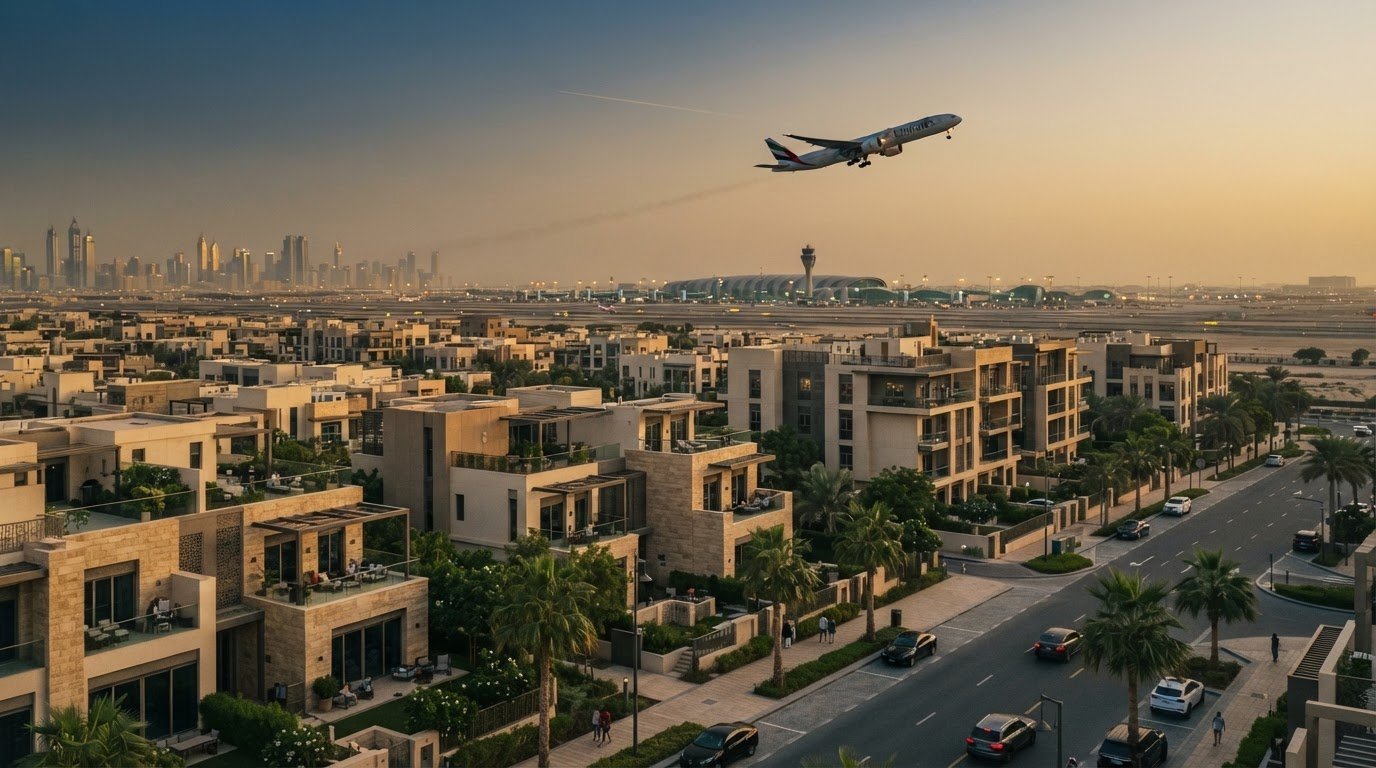
The closest property isn’t always the most convenient. Properties near Dubai Airport can appeal to frequent travellers, but a short distance on a map doesn’t show what the journey will be like day to day. Dubai International Airport (DXB) and Al Maktoum International Airport (DWC) have different access considerations, while aircraft noise, privacy and the character of a home all affect whether a location suits you.
Airport proximity can save time, but the benefit depends on your regular routes, tolerance for disruption and plans for the property. A home that works well for a frequent flyer may not suit a family seeking a quieter setting or an investor weighing rental potential. Compare the full picture rather than treating distance as a guarantee of convenience or value.
This guide explains how to assess airport access against your travel needs, what to look for when evaluating noise and privacy, and how to compare property types for different uses. It also considers the distinct context around DXB and DWC, so you can build a practical shortlist and make a more informed decision with professional property guidance.
Key Takeaways
- There’s no single distance that defines airport-adjacent living; assess how airport access fits your regular journeys and property goals.
- Compare apartments, villas, townhouses and commercial properties against the space, privacy, upkeep and access your intended use requires.
- Evaluate each property and its surroundings individually. Record what you notice about noise and privacy rather than assuming the experience is the same everywhere.
- Shortlist properties near dubai airport by recording your priorities, travel needs, property type and observations for each candidate before deciding.
- Professional property and investment guidance can help align your comparison with your objectives without assuming a particular outcome.
What Does Living Near Dubai Airport Mean for a Property Search?
“Near the airport” is best treated as a search priority, not a fixed distance on a map. For one buyer, it may mean a manageable journey to the terminal. For another, it may mean access that works for regular business travel without making the airport the main factor in choosing a home. Properties near Dubai airport can sit in very different travel contexts, so the label alone tells you little about daily convenience.
There are two airports to consider. Dubai International Airport (DXB) is centrally located and connected to the Dubai Metro, while Al Maktoum International Airport (DWC) is about 23 miles from the city centre and currently has more limited public transport. Identify which airport you expect to use most before comparing homes. A property that appears close to one terminal may be less relevant if your regular flights use the other.
Which buyers may value airport access most?
Frequent flyers, internationally mobile professionals and people whose work involves regular business travel may value a straightforward airport journey. Travel frequency isn’t the only consideration, though. School and work commutes, caring responsibilities, preferred transport and the needs of other residents can all affect how useful proximity feels.
Owner-occupiers should consider airport access alongside comfort, privacy and everyday routines. Investors have a different question: does the property’s location and type fit their intended rental or ownership strategy? Airport access may be one factor in that analysis, but it doesn’t establish demand or investment suitability on its own.
What should count as close to the airport?
There’s no universal radius that makes a property “close.” Map distance is only a starting point. The practical journey depends on the route to the terminal, available transport and the conditions at the times you typically travel. A short straight-line distance doesn’t necessarily mean a simple door-to-terminal trip.
Compare candidate properties using the journeys you expect to make. Check routes at relevant times, consider whether you’d drive or use public transport, and note how many transfers or connections the trip involves. For each option, record:
- Which airport you’re most likely to use and how often.
- Your usual departure times and preferred transport method.
- The door-to-terminal route, including any connections.
- Whether airport access supports your household routine or investment objective.
Use these notes to distinguish genuine convenience from a location that merely looks close on a map. Suitability depends on your personal travel patterns and how you intend to use the property, not distance alone. That’s a practical starting point for comparing airport-area homes and investments.
How Property Type and Intended Use Shape an Airport-Area Search
Airport access is only one part of a property decision. A home that suits a frequent traveller may not meet a household’s needs for privacy or outdoor space. An investment, meanwhile, should be assessed against a defined tenant or buyer profile. Before comparing properties near Dubai airport, decide whether your priority is everyday living, investment or a business requirement. This helps you weigh features consistently instead of letting proximity dominate the search.
Choosing a home for everyday living
Start with your household: who will live there, how much private space matters, and what does a typical week involve? Apartments, villas and townhouses can offer different balances of space, privacy, outdoor areas and upkeep. The right fit depends on the specific property and household. Consider transport and daily services alongside airport access; a convenient terminal journey may matter less if other regular journeys become difficult.
Use the same criteria for each home you view. Record usable space, privacy, outdoor needs, upkeep expectations, transport options and access to everyday services. Dubai Airports’ official DXB information can help you understand the airport’s operations, but the suitability of a particular home still depends on its features and setting.
Evaluating a property as an investment
For an investment, first define who the intended tenant or future buyer might be and what their priorities could include. Then assess rental demand and potential yield as property-specific questions. Use current market analysis rather than assuming airport proximity guarantees performance. Chainex’s investment analysis can help you compare options against your objectives. The existing guide, “How to Buy Property in Dubai: The Ultimate Guide for Investors (2026),” offers a broader framework for investor considerations.
Commercial property calls for a separate lens. Consider the access needs of the business the space is intended to serve, including how staff, clients, suppliers or visitors may reach it. Priorities vary by use, so don’t treat an airport-adjacent location as an automatic advantage for every commercial purpose.
Property type | Priorities to compare | Questions to investigate
Apartment | Privacy, layout, shared facilities and upkeep | Does the home suit the household’s routines and space needs?
Villa | Private space, outdoor needs and maintenance | Are the space and upkeep appropriate for the intended occupants?
Townhouse | Space, privacy and shared or private outdoor areas | Does its layout balance household needs with practical maintenance?
Commercial property | Business access, visitors and operational fit | How will the intended business use the location?
Apply this comparison before ranking options. A consistent set of questions makes trade-offs easier to see and keeps daily-living needs distinct from investment assumptions. If you’re assessing a purchase, Chainex can help align property comparisons with your priorities through its property buying support.
Airport Proximity: How to Weigh Convenience Against Noise and Privacy
Convenient airport access can involve trade-offs, but the experience varies between properties. Noise and privacy can depend on a home’s immediate surroundings, room orientation, building position and the conditions during a visit. Don’t assume that two homes in the same general area will feel alike, or that distance alone predicts how comfortable one will be.
A map can show where a home sits, but it can’t establish what that home actually sounds like. If you’re considering properties near Dubai airport, an in-person assessment is important, especially if noise sensitivity, quiet work areas or undisturbed sleep are high priorities.
How to investigate noise and the immediate surroundings
During a viewing, spend time indoors and outdoors. Listen in the rooms you expect to use most, and note whether the experience changes with windows open or closed. Pay attention to bedroom and living-area orientation, not just the view from the entrance. A brief visit offers only a snapshot, so record what you observe rather than treating one quiet or busy moment as a reliable pattern.
Where practical, revisit at a different time of day. Check current information from reliable airport or aviation sources about operations and flight paths, and use it as context rather than proof of a specific property’s exposure. Don’t infer aircraft activity from a map or assume a published route describes every movement. Authentic photographs of the actual property and its surroundings can help you understand the setting, but they can’t replace listening in person.
- Note where you hear sound most clearly, inside and outside.
- Record which rooms face toward or away from open surroundings and activity.
- Look beyond the property boundary for nearby roads, businesses or other sources of activity.
- Separate what you observed from what still needs further investigation.
Which convenience trade-offs deserve attention?
Weigh airport access against the journeys that shape your ordinary week. Consider work, school, errands and household responsibilities alongside travel to the terminal. A location that supports occasional flights may be less suitable if it complicates daily routines. Compare each property against the same priorities to see where the balance works for you.
Observe the approach to the property and its immediate surroundings during more than one visit where practical. Note traffic, access-road activity, pedestrian movement and how private outdoor or window-facing areas feel. These observations can reveal practical details that a listing description or map may not show.
Keep your conclusions measured. A viewing is evidence of what you experienced at that moment, not a guarantee of future conditions. Avoid drawing unsupported conclusions about safety, air quality or future property value from proximity alone. Document your observations, identify unanswered questions and weigh them against the benefits you expect from airport access. This gives you a clearer basis for comparing convenience with comfort and privacy.
How to Compare Properties Near Dubai Airport Before Shortlisting
A clear comparison process helps you move from browsing to a focused shortlist without letting one attractive feature outweigh the rest. For each candidate, separate details you can verify, such as the stated property type or listed features, from impressions gathered during a viewing, such as perceived noise or privacy. Keep unanswered questions visible instead of resolving them through assumptions.
Build a comparison framework before viewing
Before arranging viewings, rank what matters most: airport access, space, privacy, commute patterns and intended use. Apply the same questions to every option so that a spacious home isn’t judged by different standards from a conveniently located apartment. A simple notes document or table is enough. Record facts, observations and open questions separately.
Use this five-step process to turn your priorities into a practical shortlist:
- 1. Define your priorities. Decide whether the property is for everyday living, investment or another use. Rank airport journeys against household travel, space, privacy and upkeep.
- 2. Compare candidates. For each property, record its type, listed features, intended use and the airport journeys relevant to you. Note which needs it meets and where it involves a compromise.
- 3. Investigate the details. Distinguish listing information from your own conclusions. Verify relevant property details using reliable, current information, and write down anything unclear instead of treating an assumption as fact.
- 4. Revisit leading options. If practical, return at a different time or under different conditions. Reassess the rooms, immediate surroundings, access roads and noise observations rather than relying only on your first impression.
- 5. Decide against your original criteria. Review the evidence and your priorities together. A property should make sense for its intended use, not simply rank highest for airport proximity.
Turn a shortlist into an informed decision
For every option, keep a consistent record of property type, travel needs, noise observations, intended use, verified listing facts and unresolved points. For example, note the stated layout as a listing fact, but record how private a room felt during your visit as a personal observation. This distinction makes comparisons more balanced and helps you identify what needs further review.
Before moving forward, revisit your leading choices where possible and assess the surroundings again. Review transaction and ownership considerations using current, reliable information relevant to the property and your circumstances. General guidance is not a substitute for reviewing the details of a specific purchase.
Once your criteria and shortlist are clear, explore property-buying support to help move from research toward a purchase decision. A structured comparison gives you a stronger basis for discussing options and aligning next steps with your objectives.
How Chainex Can Support Your Airport-Area Property Search
A focused property search starts with your requirements, not an assumption that every home near an airport offers the same advantages. Chainex Real Estate can support your purchase search or help you assess a property for investment. The goal is to bring structure to your comparison and make trade-offs easier to evaluate, without presuming that a particular location or property type will suit everyone.
Match the search to your priorities
Start by clarifying how you intend to use the property, which type you’re considering and how often airport access is likely to matter. Travel patterns, household routines, privacy, space and everyday lifestyle requirements can all shape the brief. For an investment, the discussion may focus instead on your strategy and the questions that property-specific market analysis should address.
With those priorities established, Chainex Real Estate can help focus property comparisons and viewing discussions on what matters to you. A buyer who travels regularly may give airport journeys more weight, while a household may prioritise privacy and daily convenience. These are starting points for an individual search, not assumptions about available properties near Dubai airport or their features.
If premium options are relevant to your brief, a guide to luxury property in Dubai can offer useful context for considering that segment. Compare any option with your requirements rather than letting a property’s category or location stand in for a full assessment.
Move from research to a property discussion
A concise brief makes conversations more productive. Note your intended use, preferred property type, travel patterns, essential lifestyle requirements and any trade-offs you’re willing to consider. If you’re investing, include the questions you want the analysis to address. This gives the discussion a clear focus and helps distinguish essential criteria from preferences that may be flexible.
Chainex Real Estate can support property purchase discussions and investment analysis in line with your objectives. A clear brief gives you a considered basis for comparing options and discussing possible next steps. Keep your viewing observations and unanswered questions close at hand so the conversation reflects both your priorities and what you’ve learned about each property.
When you’re ready, share your property brief with Chainex Real Estate to discuss your search, whether you’re exploring a home for your own use or assessing an investment opportunity.
Take the Next Step With a Clear Property Brief
A shortlist is a starting point, not a commitment. Before moving forward, consider which compromises you could live with and which might affect your comfort or plans over time. That perspective can help you assess properties near Dubai airport with greater confidence, whether you’re considering a home or an investment.
You don’t need to have every detail resolved before beginning a property conversation. A clear sense of your priorities, intended use and open questions can shape a focused discussion and identify sensible next steps. Chainex can help you consider property options against your objectives, with buying support and investment analysis shaped around your requirements.
Discuss your property requirements with Chainex and take the next step at a pace that feels right for you. A considered brief and informed support can help you move ahead with greater clarity.
Frequently Asked Questions
Is buying a property near Dubai Airport a good investment?
It can be, but suitability depends on the specific property, purchase terms, intended rental or resale strategy and current market evidence. For properties near Dubai airport, access alone doesn’t establish tenant demand or future returns. Compare like-for-like property information with your objectives and assumptions. Chainex provides investment consulting and market analysis to inform that assessment, without guaranteeing performance for a particular asset or strategy.
Can you hear aircraft noise inside every property near Dubai Airport?
No. The noise experience can vary between properties and their surroundings, so it shouldn’t be assumed to be uniform. During a viewing, listen in the rooms you’d use most and in outdoor areas. Note window positions, room orientation and whether the experience changes with windows open or closed. If reliable, current operational information is available, use it as context, not as proof of the noise level inside a particular home.
How much does a property near Dubai Airport cost?
There isn’t one price that applies to every property near the airport. Cost depends on property type, specifications, condition and current market factors. Rather than relying on a generic range, compare current, like-for-like properties and review the details behind each asking price. Consider whether the property meets your intended use instead of treating airport proximity as a standalone measure of value.
What should I check during a viewing near Dubai Airport?
Assess sound indoors and outdoors, and note room orientation, window positions, access routes and activity immediately around the property. If possible, view at a time that reflects your routine, such as when you’d usually be at home or travelling. Use the same notes for each shortlisted property. Mark direct observations separately from assumptions, and verify material property or market claims through current, reliable information before deciding.
Are apartments or villas better for buyers near Dubai Airport?
Neither is universally better; the right type depends on your household and intended use. An apartment may suit someone seeking a particular balance of space and upkeep, while a villa may better meet another household’s requirements. Compare each property rather than relying on broad assumptions about either type. Consider layout, privacy, maintenance expectations, travel patterns and how the home will support your daily routines or longer-term plans.
Can international buyers purchase property near Dubai Airport?
Eligibility and ownership conditions depend on current rules and the specific property, so airport location alone doesn’t establish whether a purchase is available to an international buyer. Review current authoritative UAE requirements and property-specific information as part of your decision. Chainex can support your property search and buying discussion, helping you consider options in light of your requirements while keeping relevant conditions central to the conversation.