


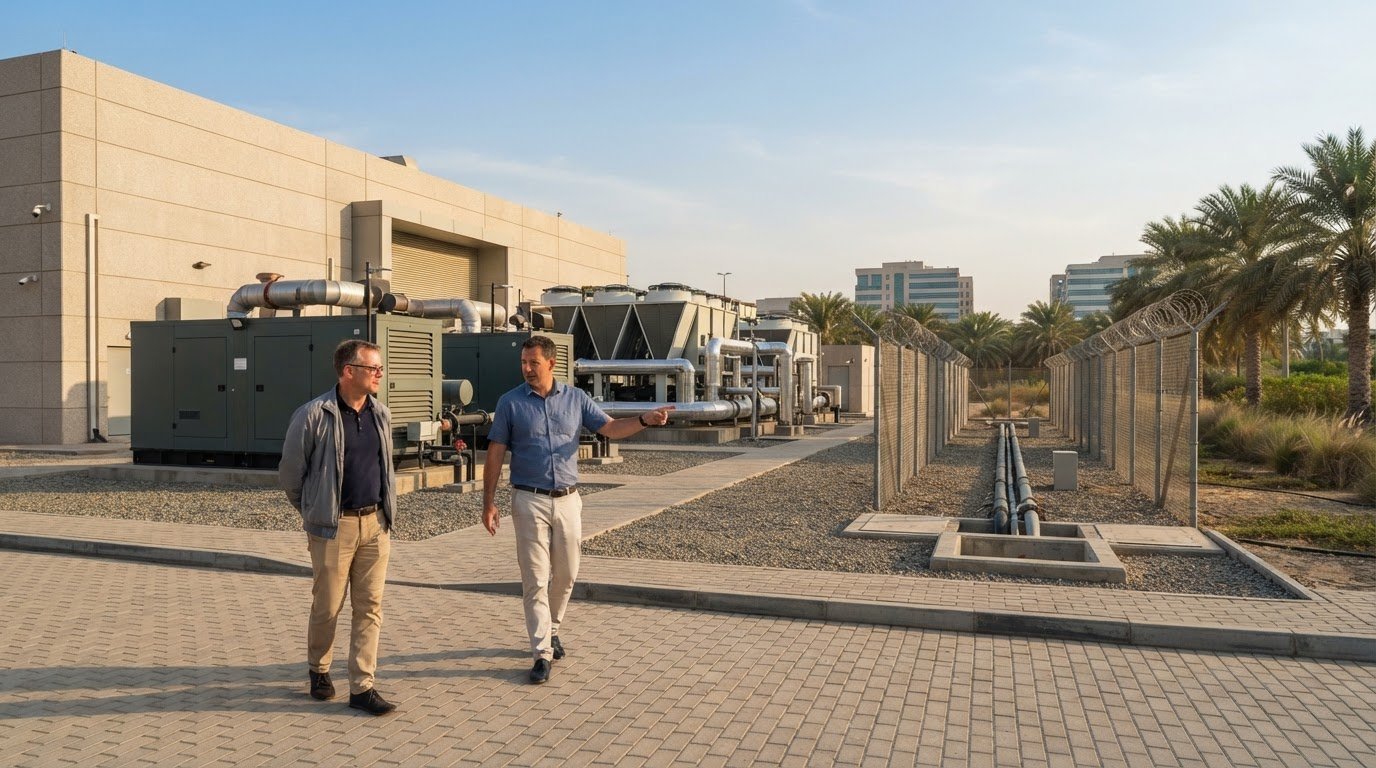
Data centres are more than rooms full of servers. They bring together the IT equipment businesses use to store, process and deliver data and applications. Servers, networking equipment, power supplies, cooling, cabling and monitoring systems work together to keep operations running. Understanding how these elements fit together clarifies the role data centres play in business infrastructure.
For organisations in the UAE, understanding how data centres operate can inform operational and investment decisions. Reliability depends on more than hardware: resilient power, effective cooling, connectivity and security all contribute to continuity. These factors also help separate a data centre’s technical requirements from the broader property considerations that may accompany an investment.
This guide explains what a data centre is, how its core infrastructure supports daily operations, and how modern facilities differ in purpose and design. It also covers why resilience and efficiency matter when assessing data centre developments in the UAE, and how commercial property expertise can inform the wider investment picture.
Key Takeaways
- Use the tier framework to understand how redundancy and maintainability influence a facility’s resilience and availability.
- Assess power, cooling, connectivity and security together; these systems support reliable operations and shape a facility’s efficiency.
- Distinguish edge, colocation and hyperscale facilities by their purpose and scale to better understand which model fits a business need.
- For a related commercial property search in Dubai, Chainex Real Estate offers commercial properties for sale.
Resilience, redundancy and availability
A facility’s reliability depends on how it handles equipment failure and maintenance. If there is no alternative, a single power, cooling or network failure can interrupt workloads. Redundancy means having backup components or routes. For example, a second power path can keep servers running while the primary path is serviced. Physical protection and network design matter too: resilience must extend beyond the server room to the connections between users, applications and stored data.
The Uptime Institute classifies data centre resilience across four tiers. Its framework helps businesses compare facility designs, but a tier label describes capabilities rather than guaranteeing uninterrupted service for every application. The Institute’s availability range across the tiers is 99.671% to 99.995%. The appropriate level depends on how much interruption a business can tolerate and what its workloads require.
Tier I provides basic capacity, including an uninterruptible power supply and 24×7 cooling. Tier II adds redundant components, including for power and cooling. Tier III facilities are concurrently maintainable: components and distribution paths support maintenance without shutting down IT equipment. Tier IV adds fault tolerance to Tier III, helping a facility withstand a component failure while continuing to operate. These distinctions matter when organisations develop infrastructure for services that depend on continuous uptime.
In the UAE, the Jebel Ali Data Center in Dubai is Uptime Tier III certified. It is a local example of a facility designed for concurrent maintenance, not a template for every site. Hyperscale operators may also assess how facilities connect across a region, because a building-level tier does not describe network diversity between locations. Facilities serving users across multiple sites need to account for those connections as well as the design of each individual site.
When assessing a design, trace dependencies across power, cooling and network routes. Identify components without a backup, then consider how maintenance or failure could affect workloads. This puts tier classifications in context: resilience needs to support the equipment, connections and recovery arrangements that services depend on.
Benefits of modern data centres
Modern data centres let organisations run workloads without tying each application to a single physical machine. Virtualisation allows multiple software-based systems to share hardware, while software-defined networking directs traffic between workloads. A retailer, for example, can distribute online services across physical equipment and cloud environments as demand changes. This flexibility helps teams allocate computing capacity and storage to applications without redesigning every system, and adapt infrastructure as business needs evolve.
Data centres support different cloud arrangements, each with its own control and management model. A private cloud provides virtual processing and storage resources for one organisation. Public cloud services are managed by third-party providers and serve multiple organisations. A hybrid model combines public or private cloud services with on-premises facilities or edge locations. Organisations can match workloads to operational needs instead of relying on one environment for every task.
Energy efficiency is another consideration. Power usage effectiveness, or PUE, compares a facility’s total power use with the power consumed by its IT equipment. A ratio of 1.0 is ideal, while the typical average in recent years is 1.58. Supporting systems, including cooling, account for energy beyond the equipment running workloads. Tracking PUE helps operators understand how facility overhead affects the energy required for computing and storage.
In the UAE, these choices sit within a wider focus on energy use. The national net-zero target is 2050. Globally, data centres used about 1.5 per cent of electricity in 2024, and electricity demand is growing by about 12 per cent annually. The UAE has announced plans for a 5-gigawatt data centre campus in Abu Dhabi. For operators, modernisation can support changing workloads while making energy use and capacity planning more visible. Data centres can therefore offer flexibility in how infrastructure is deployed, managed and expanded across different environments.
Data center definition and components
A data centre brings an organisation’s IT operations and equipment together to store, process and distribute data and applications. It houses physical hardware and supporting systems in a dedicated facility. For example, a government department could use a data centre to run internal applications and store operational records. The facility provides the physical foundation; software determines how computing resources serve individual workloads.
Core equipment has distinct roles. Servers run applications and process information, while storage systems retain files and databases. Routers and switches move data between systems and networks. Firewalls help control traffic entering or leaving protected environments. Together, these components support services such as employee portals, customer databases and business applications. Their configuration depends on the workloads an organisation needs to run.
The supporting infrastructure keeps hardware usable. Power supplies deliver electricity, and cabling connects servers, storage and networking equipment. Cooling and ventilation manage heat produced by operating hardware. Environmental monitoring tracks conditions inside the facility, helping operators identify changes that could affect equipment. These systems are part of the data center itself, not optional additions to the servers it houses.
Cloud computing changes how users access resources, but it does not eliminate the underlying infrastructure. A private cloud provides virtual processing and storage for one organisation. Public cloud services are managed by third-party providers and serve multiple organisations from remote facilities. A hybrid cloud combines public or private cloud services with on-premises or edge resources. In every case, workloads rely on physical computing, storage and network capacity somewhere in the system.
Ownership and management also vary. In colocation, responsibilities for the facility and its infrastructure are typically divided between the provider and the host organisation. A managed service data center is operated by a third party, with businesses leasing infrastructure and services. These models clarify who operates the building and who manages technology. For an organisation assessing a facility, separating those responsibilities helps explain how its applications, data storage and hardware will be supported.
Data centre types and typical scale
Facility type describes who operates a site, where it serves users, and how it supports computing demand. Typical power capacity can offer one way to compare data centre types, though scale varies between facilities. These ranges indicate broad operating scale, not a guarantee of a particular building’s size or capabilities.
Edge facilities sit close to end-users and support applications sensitive to delay. A business delivering time-sensitive services could use nearby edge capacity to process data closer to its users. Colocation sites serve a different need: organisations place their own equipment within a shared facility. The 10-100 MW typical range reflects the scale of these sites, while the customer’s equipment and workload requirements shape its use of the space.
Hyperscale facilities are massive, custom-built sites operated by a single company. They typically provide at least 100 MW of capacity and contain at least 5,000 servers. That scale can support extensive computing and storage requirements across a company’s services. Enterprise data centres, by comparison, house equipment such as servers, routers, switches and firewalls for an organisation’s applications. The distinction is principally about purpose and operation, not just the equipment inside.
In Dubai, the Dubai Silicon Oasis Authority operates two data centres, illustrating the range of operators and roles in the UAE market. A planned capacity or facility label alone does not explain what a site is suited to. Assess its intended users, location, operating model and workload profile together. A service that needs processing close to users may point toward an edge model, while an organisation building infrastructure at substantial scale may consider hyperscale capacity. Colocation can suit organisations that need facility space for their own equipment. Comparing these characteristics makes facility type more meaningful than scale alone.
Chainex Real Estate
Chainex Real Estate can support the property side of a wider UAE investment decision. Data centre infrastructure and commercial real estate are separate considerations, though both may inform an organisation’s location and asset planning. If you are exploring commercial property opportunities in the UAE, Chainex Real Estate offers commercial properties for sale.
The right property search depends on intended use, location priorities and investment objectives. Chainex Real Estate can help you assess commercial property options in that context. A real estate search is not a substitute for technical data centre planning.
For guidance on commercial property opportunities, contact Chainex Real Estate.
Plan Your Next Investment Decision
For investors considering data centres, keep infrastructure decisions separate from any property purchase. Facility requirements and real estate objectives need distinct assessments, even when they form part of a broader investment strategy. Clarifying whether you are evaluating an operational facility, commercial property or personal holdings makes the next steps more focused and helps avoid treating different asset types as interchangeable.
Chainex Real Estate can assist with property searches that complement your wider plans. Its offerings include Dubai houses for sale, villas for sale and townhouses for sale. These options may suit separate residential or portfolio objectives, while commercial property decisions remain distinct. Define your priorities first to keep each search aligned with its purpose.
Contact Chainex Real Estate to discuss your property objectives. A considered next step can bring greater clarity to your investment plans.
Frequently Asked Questions
What is a data center?
A data centre is a dedicated facility housing the physical systems behind digital services. When someone uses a banking app, for example, servers and storage systems within its infrastructure may process the request and retrieve account information. The user interacts with the app; the data centre houses the computing equipment that supports it.
Will demand for data centres continue growing amid the AI boom?
Demand is growing, with artificial intelligence contributing to rising data centre power needs during the 2020s. Global data centre electricity demand is growing by about 12 per cent a year. AI workloads require computing resources, so operators must consider how to provide capacity and energy as those workloads develop. The pace and location of demand can vary across markets and facility types.
What is a data centre and how does it work?
A data centre is the physical setting where digital workloads run: it processes requests and returns results. When a user submits an online form, for example, the application sends information to be processed, and the system can retrieve or update relevant records. The response then travels back to the user through the application.
What are the key components and infrastructure in a data centre?
Key components include servers, storage systems, routers, switches, cabling, power equipment, cooling, ventilation and environmental monitoring. Each supports a different part of operations. Servers run applications, for example, while network equipment directs information between systems. Monitoring can help operators spot changes in facility conditions, and cooling helps manage heat produced by active equipment.