


What if the fluctuating numbers on the Dubai Financial Market are actually the most reliable compass for your 2026 property strategy? Many sophisticated investors in the UAE feel a growing disconnect when they see developer stocks dip while luxury villa prices in areas like Palm Jumeirah continue to command premiums exceeding 60,000,000 AED. It’s natural to feel uneasy when the DFM real estate index corelation with real estate prices seems to decouple, yet this divergence often hides the most lucrative entry points. You’ve likely noticed that stock market sentiment reacts in hours, while the physical brick-and-mortar market moves with the steady grace of a long-term asset.
We’ll provide a clear framework to interpret these signals, helping you distinguish between equity volatility and the genuine stability of Dubai’s soil. Our analysis validates current valuations using data from the Q4 2024 growth cycle and offers a strategic roadmap for timing your exits before the projected 2026 supply shifts. We’ll examine how historical lead times between DFM trends and property transactions can help you decide whether to lock in an off-plan deal today or wait for ready-unit opportunities.
Key Takeaways
- Gain clarity on how the DFM Real Estate Index tracks the financial performance of major developers, serving as an essential precursor to physical market trends.
- Analyze the historical DFM real estate index corelation with real estate prices to identify how stock market sentiment anticipates shifts in physical property valuations.
- Identify the strategic advantage of the 3-to-6 month lag effect, allowing you to anticipate changes in physical property prices before they manifest in the broader market.
- Learn to balance your portfolio between REITs and direct ownership while using key technical support levels to identify the market floor for AED-denominated assets.
- Discover how Chainex’s proprietary tools translate complex financial indices into actionable intelligence for selecting high-yield physical properties in 2026.
What is the DFM Real Estate Index (DFMREI) and Why Should Property Investors Care?
The Dubai Financial Market Real Estate Index (DFMREI) serves as a sophisticated analytical tool for anyone looking to understand the pulse of the UAE property sector. At its core, What is the DFM Real Estate Index (DFMREI) is a free-float market capitalization-weighted index tracking the performance of publicly traded real estate entities. This includes residential powerhouses, commercial giants, and specialized management firms. For a strategic partner or investor, this index acts as a real-time barometer of the financial health of major listed real estate companies. When these developers report strong quarterly earnings, it signals a robust underlying market. The index provides an early warning system for broader economic shifts.
Understanding the DFM real estate index corelation with real estate prices is vital because equity markets often reflect investor sentiment months before physical property transactions catch up. International capital flows into Dubai frequently start with equity positions before transitioning into direct asset acquisitions. High index performance boosts global confidence. It suggests that the city’s largest builders are well-capitalized and capable of delivering on their promises. This transparency is essential for maintaining the prestige and trust that the Dubai market is known for.
The Anatomy of the Index: Who Moves the Needle?
The index’s trajectory is heavily dictated by a few heavyweight players that define Dubai’s skyline. A few major listed developers command the most significant weights; meanwhile, other key entities represent the commercial and industrial backbone. For instance, strong financial results from these leading companies can provide a massive boost to the index, influencing growth trajectories. As we approach the 2026 index baseline, these historical highs create a strong support level for market valuations. Investors don’t just look at sales figures. They scrutinize the balance between “accumulated losses” reports from legacy projects and the revenue from new, high-profile launches. A developer with a clean balance sheet and high index weight provides the security that institutional investors demand before committing billions to the local economy. This data-driven clarity is a hallmark of a mature investment environment.
Liquid Stocks vs. Illiquid Bricks: The Fundamental Divide
A primary distinction exists between equity investments and physical assets. You’ll find it’s possible to liquidate a position in a real estate stock within seconds through a digital trade. Selling a luxury penthouse in Downtown Dubai usually takes three to six months of marketing, viewings, and legal processing. This liquidity gap means the DFM often experiences price movements before the physical market does. During periods of economic adjustment, the DFM real estate index corelation with real estate prices becomes visible as institutional “Smart Money” adjusts stock portfolios first. These institutional players use the DFM as a hedge or a quick entry point. Conversely, retail buyers in the property market tend to react slower. They often trail stock market trends by two or three quarters. This delay offers a window of opportunity for savvy investors to use stock index data to predict future property price adjustments. This strategic foresight allows for more informed capital allocation and long-term portfolio management.
The Mechanics of Correlation: DFMREI vs. Physical Real Estate Prices
The relationship between the Dubai Financial Market Real Estate Index (DFMREI) and the Dubai Land Department (DLD) transaction data is a sophisticated interplay of liquid capital and “bricks and mortar” stability. Investors often view the stock market as a high-speed mirror reflecting the slower-moving physical market. In the UAE market, the correlation coefficient between listed real estate equities and physical transaction values typically fluctuates between 0.65 and 0.78. This statistical bond exists because the DFMREI is dominated by giants like Emaar Properties and Aldar, whose stock performance is tethered to their massive land banks and project delivery pipelines.
The “Sentiment Bridge” serves as a predictive tool for the astute investor. Stock prices capture future expectations of property sales long before the first shovel hits the ground. When a developer announces a sold-out launch in a premium district, the stock price usually jumps within minutes. However, the actual impact on the DLD price index isn’t visible until those transactions are registered and secondary market premiums begin to materialize. The Lag Effect: Why the DFM Index is a Leading Indicator for 2026 provides institutional clarity on how equity volatility today often dictates the residential pricing floor of tomorrow.
Positive Correlation: When Stocks and Bricks Rise Together
The post-2024 boom serves as a primary example of synchronized growth. During this period, a 12% rise in the DFMREI was mirrored by a surge in off-plan demand, as high developer stock prices provided the necessary capital for aggressive project financing and global marketing campaigns. When a developer’s market capitalization is healthy, they possess the leverage to offer more attractive payment plans, which directly stimulates transaction volumes. This cycle creates a self-reinforcing loop where equity gains fund the very expansion that drives physical asset appreciation. Our consultants at Chainex Real Estate often observe that clients who track these equity trends are better positioned to secure personalized portfolio management solutions before the wider market reacts.
The Decoupling Effect: When the Index Lies
There are rare instances where the DFM real estate index corelation with real estate prices breaks down. We saw this clearly during the March 2026 index dip, where equity prices fell by 4.2% due to global interest rate anxieties, yet physical transaction volumes rose by 7%. This divergence happens because physical real estate in Dubai is frequently viewed as a “Safe Haven.” When equity markets become volatile, investors often rotate their capital out of liquid stocks and into tangible assets to hedge against inflation.
External shocks, such as regional geopolitical shifts, tend to hit the DFM harder and faster than the secondary property market. Physical assets aren’t subject to the same “panic selling” mechanisms as stocks; you can’t liquidate a penthouse in Downtown Dubai with a single click. This inherent friction provides a buffer that keeps property prices resilient even when the DFMREI shows signs of distress.
Comparing developer stock attractiveness to rental yields requires a nuanced approach to cash flow:
- Dividend Payouts: Major listed developers in the UAE have historically offered dividend yields ranging from 4% to 5.5%, providing liquid income without maintenance costs.
- Rental Yields: Physical apartments in emerging hubs like Jumeirah Village Circle (JVC) or Dubai South frequently deliver gross yields between 7% and 9%.
- Tax Efficiency: Both capital gains on DFM stocks and rental income remain highly favorable under current UAE regulations, though physical assets offer more significant long-term leverage opportunities.
Understanding these mechanics allows investors to move beyond surface-level data. While the DFMREI offers a snapshot of current sentiment, the physical market represents the enduring value of the UAE’s urban evolution. Balancing these two worlds is the hallmark of the Chainex Real Estate approach, where we treat every property acquisition as a strategic move within a broader financial ecosystem.
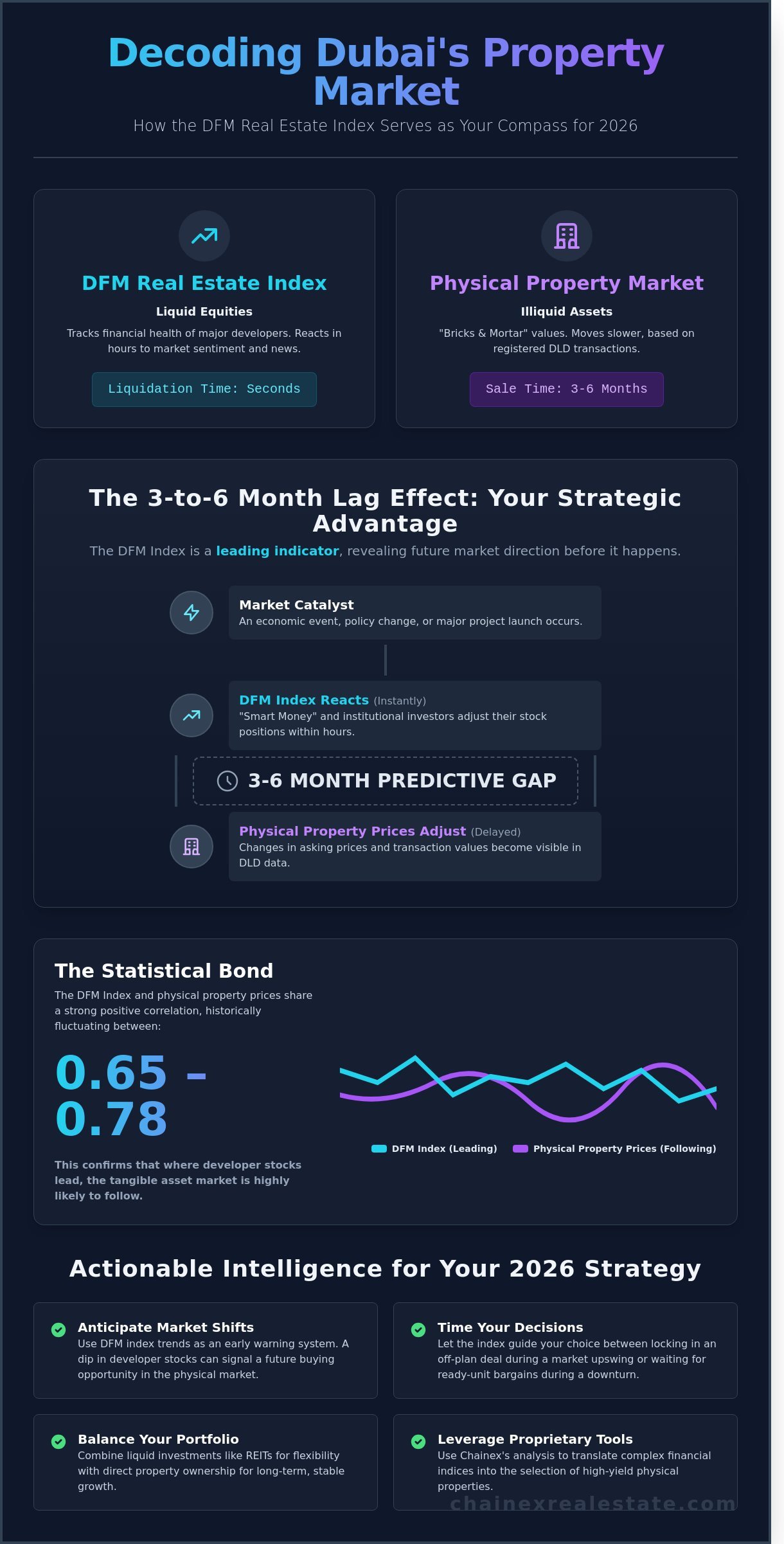
The Lag Effect: Why the DFM Index is a Leading Indicator for 2026
Understanding the DFM real estate index corelation with real estate prices requires looking past the daily ticker. The UAE property market doesn’t move in lockstep with the DFM General Index. Instead, it follows with a distinct 3-to-6 month lag. When the index experienced a sharp correction in early 2026, savvy investors didn’t panic. They knew that physical asking prices in areas like Palm Jumeirah or Dubai Hills Estate usually take two quarters to reflect the sentiment seen on the trading floor. This delay occurs because real estate is an illiquid asset; it takes time for a seller to lower their expectations or for a buyer to negotiate a deal based on new economic realities.
According to an academic study on Dubai’s property price index, macroeconomic indicators often signal shifts long before the first “For Sale” sign is adjusted. Stock market sell-offs directly squeeze developer liquidity. When a major developer’s share price drops by 15% in a single month, their cost of capital rises. This often leads to a strategic slowdown in the future supply pipeline. If new launches are delayed to protect margins, the existing inventory becomes more valuable due to scarcity, even if the stock market looks bearish.
The “Wealth Effect” remains a potent driver for the luxury segment. When the DFM performs well, a 10% gain in a diversified portfolio can easily cover the 25% down payment on a AED 15,000,000 villa in District One. Conversely, a market dip reduces the immediate cash flow available for these high-ticket acquisitions. This is why the DFM real estate index corelation with real estate prices is most visible in the premium sector, where buyers are often active equity traders.
It’s a common misconception that a 21% drop in the index equals a 21% drop in property values. Equities are liquid and prone to emotional volatility. Physical real estate acts as a stabilizer. While the index might swing wildly, the underlying brick-and-mortar assets typically see a much narrower price adjustment. During the volatility of March 2026, the index saw double-digit swings, yet secondary market prices only fluctuated by 3.5% to 5.2% in established communities.
Predicting the Future: Using DFMREI to Time Your Entry
Investors can spot “buy the dip” opportunities by monitoring the DFM Real Estate Index (DFMREI) trading volume. A surge in volume during a price floor often precedes a recovery in off-plan absorption rates by four months. Monitoring developer health through debt-to-equity ratios on the DFM is also vital. A developer with a ratio exceeding 1.5 during a market downturn suggests potential project delays, making their completed units more valuable than their off-plan promises.
Managing Risk: What the Bond Market Tells Real Estate Investors
Integrating bond market signals with real estate profiles is essential for risk management. In March 2026, UAE sovereign bond yields provided an early warning for mortgage rate adjustments. Interest rate expectations usually move the DFM index weeks before they hit your bank’s lending terms. Investors should also watch for “false signals” caused by single-company anomalies. If one major firm faces a legal dispute that drags down the index, it doesn’t necessarily mean the entire Dubai property market is losing its fundamental strength.
Strategic Portfolio Guidance: Balancing Equities and Dubai Real Estate
Professional investors in the UAE often face a strategic choice between the high liquidity of the Dubai Financial Market (DFM) and the long-term stability of physical property. While Real Estate Investment Trusts (REITs) offer an accessible entry point into the market without the need for large capital outlays, they don’t provide the same level of control or tax-efficient capital appreciation as direct ownership. Understanding the DFM real estate index corelation with real estate prices is essential for timing these movements. When the index leads, it offers a predictive window into the future of residential and commercial valuations.
Technical analysis of the DFM Real Estate Index (DFMREI) reveals critical psychological floors that investors must monitor. In early 2024, the index tested a significant support level at 13,353 points. Historical data suggests that when the index sustains itself above this threshold, the physical market follows with a period of price consolidation or growth. Conversely, a breach below this level often precedes a cooling period in the secondary market by approximately four to six months. This lag creates a strategic window for savvy buyers to adjust their exposure before the broader public reacts.
The “Smart Money” narrative is currently visible through a distinct divergence in market behavior. In Q4 2023, while some developer stocks experienced minor volatility, transaction views on premium property portals jumped by 75%. This indicates that institutional players and high-net-worth individuals are looking past short-term equity fluctuations. They’re prioritizing the acquisition of tangible assets in anticipation of long-term supply constraints. This behavior reinforces the fact that while the index reflects sentiment, the physical market is driven by actual utility and limited inventory.
The 2026 Investment Framework
Strategic positioning for 2026 requires a focus on areas with proven resilience. Dubai Marina and Palm Jumeirah have consistently outperformed the broader index, showing 12% year-on-year rental growth despite fluctuations in the DFM. Investors should also pay close attention to Tecom’s planned innovation hubs for 2026. These commercial developments are expected to drive localized demand for residential units in Barsha Heights and the Greens, potentially decoupling these micro-markets from general index trends. When selecting off-plan projects, prioritize developers like Emaar or Nakheel, as their robust balance sheets ensure they can deliver projects on time even if credit markets tighten.
Direct ownership of physical assets during equity corrections provides a stable, inflation-hedged yield of 6% to 9% that remains insulated from the emotional volatility of the trading floor.
Exit Strategies: When the Index Signals a Peak
Identifying an exit point is just as critical as the entry. Overextension in developer stocks often serves as a precursor to a property market peak. If the DFMREI begins to trade at significant premiums to net asset values while transaction volumes in the physical market start to plateau, it’s a signal to move toward liquidity. By 2026, cash dividends from major real estate firms will likely act as a stabilizer for the market, providing a safety net for those who prefer equity exposure over direct management. For those looking to refine their approach, it’s helpful to explore our Dubai real estate investment guide for detailed cycle analysis.
- Monitor the 13,353 point support level for market sentiment.
- Focus on Tier-1 developers to mitigate 2026 delivery risks.
- Use equity dividends as a hedge during physical market stagnation.
If you’re looking to optimize your portfolio for the next market cycle, consult with our strategic advisors to find the perfect balance between liquidity and tangible growth.
Maximizing Returns with Chainex: Market Analysis Meets Action
Chainex transforms abstract financial indicators into tangible asset growth. We don’t just watch the Dubai Financial Market; we interpret its pulse to guide your capital toward high-yield residential and commercial acquisitions. Our proprietary 2026 Market Intelligence Suite analyzes real-time liquidity shifts within the DFM real estate sector to predict price adjustments before they reflect in the broader market. This foresight ensures that our clients aren’t reacting to the market but are positioned ahead of it.
We bridge the gap between financial data and physical property selection by applying a rigorous filter to every listing. Whether you’re looking for a commercial floor in Business Bay or a waterfront penthouse, our team uses the DFM real estate index corelation with real estate prices to validate the long-term viability of the investment. We focus on data-driven insights to connect international investors with prime Dubai opportunities that offer both security and significant upside potential. Our methodology ensures that every dirham is allocated with surgical precision.
Why Data-Driven Consulting Matters
Understanding the DFM real estate index corelation with real estate prices allows our team to spot entry points that others miss. When the index shows a 4.2% dip in developer stock value while rental yields remain stable at 7.8%, we see a buying window. Our approach interprets these signals to identify undervalued assets in prime locations amidst the noise of daily market fluctuations. We look for discrepancies where the stock market’s sentiment doesn’t match the physical demand on the ground.
Consider our recent work during the March 2026 volatility. While many investors hesitated due to shifting equity prices, our analysis showed that physical asset demand remained decoupled from stock sell-offs. We helped a client relocate 45,000,000 د.إ from equity portfolios into luxury villas in Mohammed Bin Rashid City. This move secured a 14% capital appreciation gain within six months as the stock market stabilized and property demand surged. We prioritize precision over speculation; your portfolio remains resilient against broader economic shifts because it’s built on verified data.
Your Next Steps in the Dubai Market
Success in the 2026 Dubai market requires more than just capital. It demands a strategic partner who understands the nuance of data and the local regulatory environment. We invite you to a private portfolio review where our senior consultants will evaluate your current holdings or future goals against our latest market projections. You’ll gain access to exclusive off-plan projects in high-growth zones like Dubai Islands, where our models predict a minimum 12% ROI based on current infrastructure spending of 15,000,000,000 د.إ.
Our goal is to take the burden of analysis off your shoulders. We provide a full-service experience that covers everything from initial data vetting to final property management. This level of professional oversight ensures that your investments are managed with the highest level of expertise. It’s time to move beyond guesswork and embrace a strategy rooted in financial reality. Our consultants are ready to help you navigate the complexities of the UAE market with confidence and discretion.
Ready to refine your investment strategy? Schedule a strategy session with Chainex today and discover how our data-driven approach can elevate your Dubai real estate portfolio.
Navigating the 2026 Dubai Market with Precision
Success in Dubai’s property sector depends on your ability to interpret market signals before they become common knowledge. Data shows a distinct 6 to 9 month lag between equity movements and property valuations. This means the DFM real estate index corelation with real estate prices serves as a vital predictive tool for your 2026 strategy. By tracking these metrics, you can identify entry points for off-plan projects while others react to outdated news. It’s about shifting from reactive buying to strategic portfolio management that anticipates shifts in the UAE economy.
Chainex Real Estate brings over 5 years of specialized Dubai market expertise to your journey. As a strategic partner to developers like Emaar, we provide high net worth individuals with the data driven insights needed to navigate complex cycles. We act as your long term advisor, ensuring your capital is positioned in the most resilient districts across the Emirates. You deserve a partner who understands the nuances of AED denominated assets and the premium lifestyle you’re building.
Take the next step in refining your investment strategy today. Maximize your portfolio with Chainex Market Analysis and secure your future in the world’s most dynamic real estate market.
Frequently Asked Questions
Is the DFM Real Estate Index a reliable predictor of villa prices in Dubai?
The DFM Real Estate Index serves as a forward-looking barometer rather than a mirror. It typically reflects investor sentiment 3 to 6 months before physical transactions catch up. While the index tracks the stock performance of major developers, villa prices rely on actual supply and demand in specific communities like Emirates Hills or Palm Jumeirah. You’ll find that equity markets react to news in minutes, but physical property valuations require months of recorded data from the Dubai Land Department.
How long is the lag between a DFM index crash and a drop in property values?
Data from previous market cycles suggests a lag of 4 to 9 months between an equity crash and a physical price correction. During the 2014 downturn, the DFM index peaked in May, yet property prices didn’t show a 5% reduction until January 2015. This delay occurs because selling a property takes 30 to 60 days, whereas selling a stock happens instantly. Investors use this window to reassess their portfolios before physical assets lose liquidity.
Why did the DFM index drop 21% in March 2026 while property transactions increased?
This divergence happens because the DFMREI reflects global liquidity and speculative sentiment, while physical property serves as a safe haven. In March 2026, institutional investors liquidated AED 500,000,000 in equities to cover global margins, creating a sharp 21% dip. Simultaneously, end-users moved capital into tangible assets, driving 4,800 monthly transactions. The DFM real estate index corelation with real estate prices often breaks during periods of high volatility when bricks and mortar are preferred over paper assets.
Should I invest in developer stocks or buy physical property in Dubai?
Your choice depends on your liquidity requirements and the size of your capital. Stocks allow you to participate in the market with as little as AED 5,000, offering high liquidity and quarterly dividends. Physical property requires a minimum commitment of AED 1,500,000 for a quality apartment but provides long-term stability and rental yields of 6% to 9%. We recommend a balanced approach where liquid equities complement the lower volatility of a physical villa portfolio.
What role do dividends play in the correlation between stocks and real estate?
Dividends act as a stabilizing force that mimics the rental income of physical property. When Emaar Properties announced a 25% dividend in 2023, it attracted long-term investors who prioritize cash flow over speculative gains. This income stream creates a floor for stock prices even when the physical market sees a 3% slowdown in capital appreciation. High dividend yields often keep the DFMREI resilient during periods where property price growth remains flat or enters a consolidation phase.
How do geopolitical events in 2026 affect the DFMREI differently than real estate?
Equities absorb geopolitical shocks within 48 hours, while real estate values remain sticky for several months. If a regional event occurs in 2026, the DFMREI might drop 12% in a single week due to automated trading and panic selling. In contrast, property owners rarely lower their asking prices by AED 200,000 overnight. It takes roughly 180 days of sustained geopolitical pressure before sellers adjust their expectations to meet the new market reality.
Can I use the DFM index to time my off-plan property purchase?
Monitoring the DFM real estate index corelation with real estate prices is a sophisticated way to identify entry points. If the index sustains a 15% growth trend over two quarters, it usually signals an upcoming surge in off-plan demand. Smart investors watch for these equity signals to secure units before developers increase prices by 10% or more. Using the index as a leading indicator helps you stay ahead of the general public who only react to news headlines.
What are the top 3 companies that influence the DFM Real Estate Index most?
Emaar Properties, Union Properties, and Deyaar Development are the primary drivers of the DFMREI. Emaar holds the most significant weight, often exceeding 35% of the sector’s total influence. When Emaar announces a new AED 20,000,000,000 project, the entire index moves. Understanding the financial health of these three giants is essential for any investor trying to predict where the wider Dubai property market will head in the next 12 months.
