



The golden age of Dubai distress deals, as many remember it, is over. But for the discerning investor of 2026, a new, more discreet era of opportunity has just begun. It’s completely understandable why you’re skeptical. Your social media is likely saturated with “Urgent Sale!” listings that feel more like marketing ploys than genuine bargains, making the fear of missing out on a real deal, or worse, buying into a hidden liability, a constant concern.
This is your definitive reality check. We will reveal the truth about whether a legitimate Dubai real estate distress deal exists in today’s robust market and provide the professional clarity you need. By the end of this article, you will possess a precise framework for identifying authentic undervalued assets, understand the critical legal safeguards to protect your capital, and know how to access the exclusive, off-market opportunities that never reach public portals. Let’s separate fact from fiction and position you to secure true value with confidence.
Key Takeaways
- Understand the crucial difference between a simple price drop and a genuine distress deal by learning to analyze the seller’s motivation, not just the asking price.
- Learn why the answer to “do a Dubai real estate distress deal exist?” is yes, and discover the professional channels required to access these off-market opportunities.
- Protect your capital by mastering the essential due diligence process, including how to independently verify a property’s legal ownership through official records and digital platforms.
- Evaluate the distinct risk and ROI profiles of distress deals compared to off-plan and secondary market investments to build a high-performance property portfolio.
The Reality of Dubai Real Estate Distress Deals in 2026
In the dynamic and high-growth environment of Dubai’s 2026 property market, the concept of a “distress deal” is frequently misunderstood. Many investors equate it with simply finding a cheap property. This is a fundamental error. A true distress deal is not defined by its price tag alone, but by the seller’s urgent, non-negotiable motivation to liquidate an asset. It’s the critical difference between an underpriced property with potential hidden flaws and a high-quality asset sold below its market value due to circumstances entirely unrelated to the property itself.
Even as the market demonstrates robust performance, with average capital gains of 8-12% in prime areas over the last 18 months, specific micro-conditions and personal situations ensure that a Dubai real estate distress deal exists for the discerning investor. The key is understanding the economic and human factors that create these unique opportunities. It’s a landscape where liquidity is king. A seller’s immediate need for cash, often within a 30 to 45-day window, can outweigh their desire to hold out for the highest possible market price, creating a window of opportunity for a buyer who can act with speed and certainty.
Distressed Seller vs. Distressed Property
The primary distinction an investor must make is between a seller in distress and a property that is distressed. A motivated seller might be facing a personal or financial deadline, such as a divorce settlement requiring the immediate division of assets, an unexpected job relocation to another country, or a business needing to free up capital. In these scenarios, the urgency of the seller is your strategic advantage. Conversely, a distressed asset often comes with significant liabilities, like unresolved legal claims, structural issues discovered post-inspection, or substantial outstanding service charges that could exceed AED 70,000, ultimately negating any initial discount.
Market Sentiment and Timing
The broader economic climate of 2026 directly influences the frequency of these deals. With benchmark interest rates stabilizing around 5.25% in the first half of the year, property owners with variable-rate mortgages secured between 2022 and 2024 are feeling the pressure of increased monthly payments. This economic strain can be a powerful catalyst for a quick sale. Understanding these cycles is crucial, and a brief look into the history of Dubai’s real estate market shows how global economic shifts consistently create pockets of opportunity. Furthermore, seasonal trends play a significant role; the April-June period often sees a rise in listings as expatriate families prepare to relocate before the new academic year. Similarly, the delivery of over 40,000 new residential units in 2025 has increased competition for older buildings in established communities, compelling some owners to offer more attractive terms to secure a sale against newer, more modern inventory.
Why Distress Deals Occur: The Mechanics of Urgency
Contrary to common belief, the existence of a distress deal isn’t always a symptom of a declining market. In a dynamic global hub like Dubai, these opportunities are more often born from individual circumstances that create a powerful, time-sensitive need for liquidity. The seller’s motivation is not about market sentiment; it’s about the urgent need to convert a fixed asset into immediate cash. Understanding these drivers is the first step in identifying genuine value where others only see a standard listing. The reasons are multifaceted, ranging from personal financial shifts to complex international obligations.
At the individual level, a seller may face a sudden need for capital for a new business venture, an unexpected family matter, or a divorce settlement that requires the swift division of assets. While the broader market remains robust, as supported by the IMF 2026 economic outlook for the UAE, these personal financial pressures ensure a consistent supply of motivated sellers. This is precisely why a Dubai real estate distress deal exists even in a thriving economy; the opportunity cost of waiting months for a market-price offer is simply too high for the seller.
International investors also contribute to this unique market segment. A change in tax law in an owner’s home country, for instance, could suddenly make holding a Dubai property fiscally inefficient, prompting a rapid sale to rebalance their global portfolio. Similarly, institutional real estate funds operate on fixed timelines, typically 7-10 years. As a fund reaches the end of its life cycle, its managers are obligated to liquidate all assets to return capital to their investors. This contractual deadline can force the sale of prime properties at a discount, irrespective of the current market performance.
Banking and Foreclosure in Dubai
When mortgage defaults occur, the process in the UAE is highly regulated and methodical, differing significantly from other global markets. Banks must obtain a court order to proceed, and the sale is overseen by the Dubai Land Department (DLD) to ensure full transparency. Financial institutions often prefer to avoid the public auction process, as a private, negotiated sale can yield a better recovery value. This creates a small but valuable window for ‘pre-auction’ acquisitions for buyers who are ready to act decisively.
Expatriate Liquidity Events
Dubai’s large expatriate population is another key source of time-sensitive sales. A senior executive suddenly reassigned to another continent or an inheritance case involving multiple beneficiaries scattered across the globe often results in a property that must be sold quickly. For these owners, the carrying costs and complexities of remote management make a fast, discounted sale a far more attractive proposition. A legally attested Power of Attorney (POA) is the critical instrument that allows these transactions to conclude rapidly, enabling a designated representative in Dubai to sign contracts and complete the transfer on behalf of the overseas owner.
Identifying these nuanced situations requires more than just browsing public listings; it demands deep market intelligence and a network capable of sourcing exclusive off-market opportunities. The key is recognizing that for these sellers, speed and certainty are worth more than the final closing price.
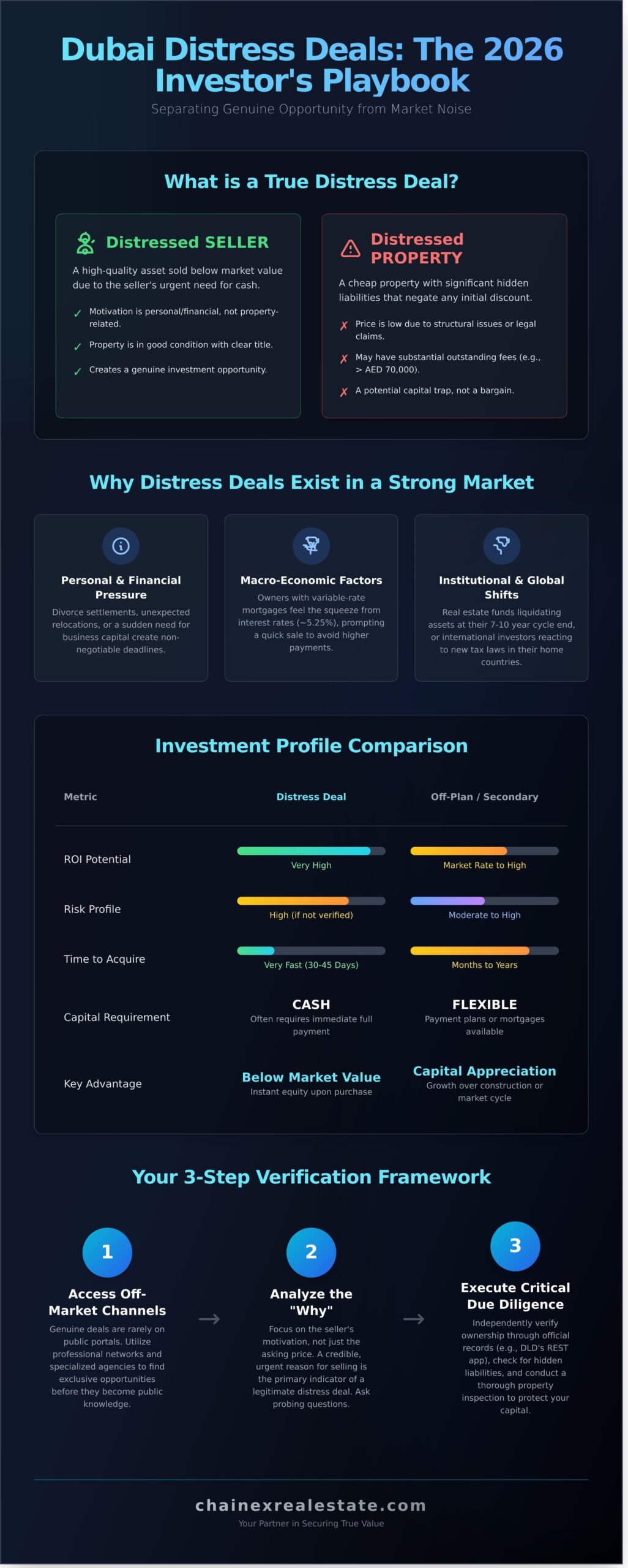
Distress Deals vs. Off-Plan vs. Secondary Market
An investor’s strategy in Dubai’s dynamic property market is defined by their choice of entry point. The decision between a distress deal, an off-plan project, or a standard secondary market property is a strategic one, balancing potential returns against risk, capital requirements, and timelines. Each path offers a distinct value proposition, and understanding these differences is fundamental to successful portfolio management.
While off-plan investments attract those focused on long-term capital appreciation and modern amenities, and the secondary market offers stability, distress deals occupy a unique niche. They cater to the agile investor seeking immediate equity and superior yields, provided they are prepared for the rigorous demands of the transaction. The question isn’t just about finding a good property; it’s about aligning the acquisition method with your financial objectives.
The Yield Perspective
The most compelling argument for a distress deal is its immediate impact on your return on investment (ROI). Unlike off-plan properties, which generate no income during their 2- to 4-year construction period, a distressed asset is a ready unit that can be tenanted immediately. This allows for the calculation of a Net Initial Yield from day one. As detailed in recent UAE property market analysis, the market’s transition to a more measured growth phase may increase opportunities for such value-driven acquisitions. Consider this practical example:
- Scenario: A 2-bedroom apartment in Dubai Marina with a market value of 2,000,000 د.إ is acquired through a distress sale for 1,700,000 د.إ (a 15% discount).
- Annual Rent: 130,000 د.إ
- Annual Service Charges: 25,000 د.إ
- Net Initial Yield: (130,000 – 25,000) / 1,700,000 = 6.17%
An identical property purchased at the full market price would yield only 5.25%. This immediate 17.5% increase in yield, combined with the instant 300,000 د.إ in equity, demonstrates why savvy investors confirm that a lucrative Dubai real estate distress deal exist for those with the resources to act decisively.
Entry Barriers and Cash Requirements
The primary barrier to entry for distress deals is the need for liquidity and speed. Cash is king. A seller in a distressed situation is motivated by the need for a fast, guaranteed closing, which the standard mortgage process often cannot provide. While a standard secondary market purchase may require a 20% down payment for financing, a distress deal almost always necessitates a cash purchase or a significantly higher down payment (often 50% or more) to secure the Memorandum of Understanding (MOU).
The MOU period is where the pressure intensifies. The 10% security cheque is often expected to be a manager’s cheque, encashed immediately to prove commitment. The timeline from MOU signing to property transfer is compressed, sometimes to as little as 14-21 days, leaving no room for financing delays or prolonged negotiations. This accelerated process is a key reason why these opportunities are inaccessible to the average buyer and require expert guidance to navigate successfully.
How to Find and Verify Genuine Distress Deals
Securing a high-value distress deal requires more than just luck; it demands a systematic process of discovery and rigorous due diligence. The most compelling opportunities are rarely advertised, and verifying their legitimacy is a non-negotiable step to protect your investment. The fact that a genuine Dubai real estate distress deal exists is confirmed not by a low price tag alone, but by a meticulous, multi-stage verification process. Follow this five-step framework to navigate the landscape with confidence.
Step 1: Establish a ‘First-Look’ Relationship with a Specialized Broker
The most lucrative deals are sourced through professional networks, not public listings. A specialist broker with deep market penetration receives ‘first-look’ opportunities from banks, insolvency practitioners, and sellers needing urgent liquidity. This relationship acts as your primary filter, saving you from navigating a sea of overstated “bargains” and providing access to pre-vetted assets.
Step 2: Verify Ownership via the Dubai REST App
Once a potential property is identified, the first technical step is to confirm ownership. The Dubai Land Department’s (DLD) official REST (Real Estate Self Transaction) app is an indispensable tool. By entering the property details, you can instantly verify the current owner’s name against the Title Deed for a completed property or the Oqood for an off-plan unit. Any discrepancy is an immediate red flag.
Step 3: Conduct a Comparative Market Analysis (CMA)
A “distress” price is only meaningful relative to the property’s true market value. A professional CMA is essential. This analysis goes beyond simple portal listings and examines actual DLD transaction data for at least three comparable properties sold within the last 90 days in the same building or community. The goal is to establish a clear baseline price per square foot, proving the discount is tangible and not just a marketing tactic. An authentic deal should present a discount of at least 15-20% below this established market value.
Step 4: Assess the Full Liability Profile
A low sale price can conceal significant financial liabilities. A thorough assessment must include obtaining official statements for any outstanding service charges from the building management, a liability letter from the seller’s bank if the property is mortgaged, and a final settlement confirmation for DEWA utilities. These costs must be factored into your total acquisition price to understand the true net cost of the investment.
Step 5: Execute a Rapid and Legally Sound MOU
Distress deals operate on accelerated timelines. Once due diligence is complete, you must move swiftly to secure the property with a Memorandum of Understanding (MOU), also known as the DLD’s Form F. This document must be drafted with legal precision to protect your interests, outlining all terms, timelines, and responsibilities clearly, leaving no room for ambiguity.
The Verification Checklist
Before committing, ensure every item on this checklist is addressed. This is where a potential Dubai real estate distress deal exists in theory but is confirmed in practice. Your broker should manage this process seamlessly.
- Outstanding Service Charges: Obtain a current, dated statement directly from the developer or owners’ association management.
- Seller’s Authority: If the seller is using a Power of Attorney (POA), verify its validity and ensure it explicitly grants the power to sell the specific property.
- The DLD’s ‘Form F’ is not merely a preliminary agreement; it is the foundational contract that legally binds both buyer and seller to the transaction’s terms.
Sourcing Off-Market Opportunities
The most sought-after distress deals never appear on Dubizzle or social media. These are typically ‘Pocket Listings’-off-market properties sold discreetly to protect the seller’s privacy or the asset’s perceived value. This is especially common in Dubai’s luxury sector, where high-net-worth individuals prioritize confidentiality. At Chainex, we leverage long-standing relationships with major Dubai developers and financial institutions to gain exclusive access to these opportunities before they ever enter the public domain. For access to our portfolio of verified off-market opportunities, contact a Chainex specialist today.
Securing Your Investment with Chainex Real Estate
Identifying a promising distress deal is only the beginning. The critical next phase involves verification, negotiation, and swift execution, a process where inexperienced investors often falter. At Chainex Real Estate, we transform this complex challenge into a seamless, strategic opportunity. We understand that in this competitive market, a genuine Dubai real estate distress deal exists for only a fleeting moment, and our entire methodology is engineered to capitalize on it with precision and discretion.
Our approach is built on a rigorous qualification process we call the ‘Distress Filter’. For every 100 listings marketed as “distress” or “motivated seller,” our analysts find that only one, on average, meets our stringent investment criteria. The other 99 are typically over-leveraged properties, listings with legal encumbrances, or simply marketing tactics. Our vetting protocol is exhaustive and non-negotiable:
- Title Deed Verification: We conduct an immediate check with the Dubai Land Department (DLD) to confirm ownership and identify any mortgages or legal notices.
- Financial Due Diligence: Our team verifies the status of service charges, ensuring there are no hidden liabilities that could erode your returns. A property with over AED 50,000 in arrears, for example, is immediately flagged.
- True Market Value Analysis: We perform a comprehensive Comparative Market Analysis (CMA) using real-time transactional data, not just listing prices. A true distress deal must be priced at least 15% below the current, verified market value to proceed.
This meticulous process ensures that the opportunities we present are not just discounted, but fundamentally sound investments poised for significant capital appreciation. The Chainex advantage is our synthesis of speed and silence. Our deep-rooted network in key districts like Business Bay grants us access to off-market opportunities, allowing our clients to act before a property is exposed to wider competition. We don’t just facilitate a transaction; we provide strategic consulting for high-yield portfolio expansion, ensuring each acquisition aligns with your long-term financial objectives.
Tailored Investment Consulting
Our partnership extends far beyond the point of sale. We offer comprehensive property management services to optimize your new asset for rental yield from day one. To empower your decisions, our clients receive exclusive market analysis reports, including our proprietary 2026 and 2027 rental and sales projections for key Dubai communities. Contact our Clover Bay Tower team for a private consultation to begin building your strategic real estate portfolio.
The Chainex Promise of Transparency
Trust is the cornerstone of every successful investment. We provide complete legal support through our vetted network of real estate lawyers, ensuring every contract is secure and every transfer is seamless. Our fee structures are presented upfront with absolute clarity, containing no hidden administrative costs or post-transaction surprises. The price we agree upon is the price you see on your final statement. This is our unwavering commitment to you.
The most lucrative deals are never publicly advertised. They are secured by those with the right connections and the readiness to act. To gain access to these exclusive opportunities, we invite you to join our private investor list. You’ll be the first to know when a verified distress deal becomes available. Register for our Distress Deal Alert List today and let us show you that a profitable Dubai real estate distress deal exists as a tangible, high-value asset for the discerning investor.
Securing Your Advantage in the 2026 Dubai Market
The Dubai property landscape of 2026 presents a nuanced reality for investors. The primary takeaway is that while opportunities for a genuine Dubai real estate distress deal exist, they are not publicly advertised. These are rare, high-value assets reserved for the decisive and well-connected. Success doesn’t come from searching public listings; it comes from having a strategic partner who can identify, validate, and secure these exclusive properties with speed and discretion before they reach the open market.
This is the strategic edge Chainex Real Estate provides. Our expert team, based in the heart of Business Bay, leverages exclusive access to off-market secondary units to position our clients for exceptional returns. We offer more than transactions; we provide full-service property management and consulting to safeguard your portfolio’s long-term growth. Don’t navigate this complex market alone. Secure Your Next High-Alpha Investment with Chainex and let our expertise transform market opportunity into your tangible success.
Frequently Asked Questions About Dubai Distress Deals
Are distress deals in Dubai actually legal and safe?
Yes, distress deals are entirely legal and safe when managed with professional expertise. The Dubai Land Department (DLD) regulates all property transactions, ensuring transparency and security. The key to a safe investment is comprehensive due diligence, which includes verifying the title deed, clearing any outstanding liabilities, and ensuring a smooth transfer process. A trusted partner like Chainex navigates these complexities, guaranteeing a secure and legally sound acquisition for our clients.
How much of a discount should I expect from a real distress deal?
A genuine distress deal in Dubai typically offers a discount of 15% to 25% below the current, accurately assessed market value. This range depends on factors like the seller’s level of urgency, the property’s condition, and its specific location. For instance, a prime apartment in Dubai Marina might fetch a 15% discount, while a villa requiring a rapid sale could command a more significant reduction. Our team provides precise valuations to confirm the true value of every opportunity.
Can I use a mortgage to buy a distressed property in Dubai?
Yes, you can use a mortgage, but it requires exceptional preparation and speed. Sellers in these situations prioritize cash buyers for a faster transaction, often aiming to close within 7-10 working days. Therefore, having a formal mortgage pre-approval is absolutely essential before you even begin your search. This readiness demonstrates your seriousness as a buyer and allows you to compete with cash offers, though the tight timeline remains a significant challenge for most lenders.
What are the hidden costs associated with buying a distress deal?
The primary potential costs beyond the purchase price are outstanding service charges and unforeseen maintenance issues. To mitigate this, our due diligence process mandates a No Objection Certificate (NOC) from the developer, which confirms all service fees are settled by the seller. We also strongly advise a professional property inspection, typically costing between AED 1,500 and AED 3,000, to provide a clear budget for any necessary repairs or upgrades before you commit.
How fast do I need to move once a distress deal is identified?
You must be prepared to make a decisive move within 24 to 48 hours. These high-value opportunities attract significant interest from savvy investors and are rarely on the market for long. The seller’s priority is a swift, uncomplicated sale. A buyer who can immediately present a credible offer, backed by proof of funds, holds a powerful negotiating position. Proactive preparation is the single most important factor for success in this niche market.
Why do sellers choose distress sales over waiting for a better price?
Sellers typically choose a distress sale due to an urgent, non-negotiable need for liquidity. Common reasons include sudden job relocation, urgent business capital requirements, or the need to settle outstanding debts. For these individuals, the certainty and speed of a cash transaction, even at a 15-20% discount, outweigh the potential for a higher price after months of waiting on the open market. It’s a strategic decision where time is more valuable than maximum profit.
Does Chainex verify the ‘distressed’ status of all listed deals?
Absolutely. Our rigorous verification process is a cornerstone of the Chainex approach to client security. Before presenting any opportunity, we conduct thorough due diligence to confirm the legitimacy of the seller’s situation, verify a clear title deed with the DLD, and ensure no legal or financial encumbrances exist. We ensure a genuine Dubai real estate distress deal exist so our clients can proceed with complete confidence, knowing the investment is both valuable and secure.
What happens if there are outstanding service charges on the property?
The settlement of all outstanding service charges is a mandatory legal requirement for the property transfer to be completed. The seller is obligated to clear these dues in full to obtain the final No Objection Certificate (NOC) from the building’s developer or owners’ association. As your representative, Chainex ensures this critical step is completed and verified before your funds are released, protecting you entirely from inheriting the previous owner’s financial liabilities.
