



In April 2024, Dubai witnessed a record-breaking 259mm of rainfall in 24 hours, causing many investors to scrutinize their Sales and Purchase Agreements with fresh eyes. You might be holding a contract for an AED 3,500,000 property in Dubai Hills, feeling the weight of uncertainty as construction timelines shift. Determining the validity of a force majeure clause within your contract, and understanding precisely when and how it can be invoked, is vital for any serious investor who wants to avoid losing significant deposits. It’s completely understandable to feel concerned when “unprecedented events” are used as a shield against developer accountability.
We’re here to provide the clarity you need to navigate these sophisticated legal waters. This guide ensures you master the legal complexities of force majeure clauses in UAE real estate to protect your investments from unforeseen disruptions. We’ll break down the “impossibility” threshold under UAE Civil Code Article 273, provide a specific documentation checklist for 2026, and explain exactly how RERA adjudicates these high-stakes disputes to keep your portfolio secure.
Key Takeaways
- Understand the rigorous legal criteria under UAE Civil Code Article 273 to distinguish between mere contractual difficulty and the total impossibility of performance.
- Master the essential steps for invoking force majeure in Contract if when how to navigate strict notification deadlines and meet the heavy burden of proof required in Dubai.
- Identify common pitfalls in off-plan property agreements, including how to challenge developer-friendly clauses and the reality behind the 12-month construction grace period.
- Implement strategic mitigation efforts and meticulous documentation to safeguard your capital and protect your AED-denominated real estate portfolio from unforeseen disruptions.
- Leverage Chainex Real Estate’s professional approach to risk management by vetting developer track records and identifying legal red flags before signing any binding agreement.
What is Force Majeure in the Context of UAE Real Estate?
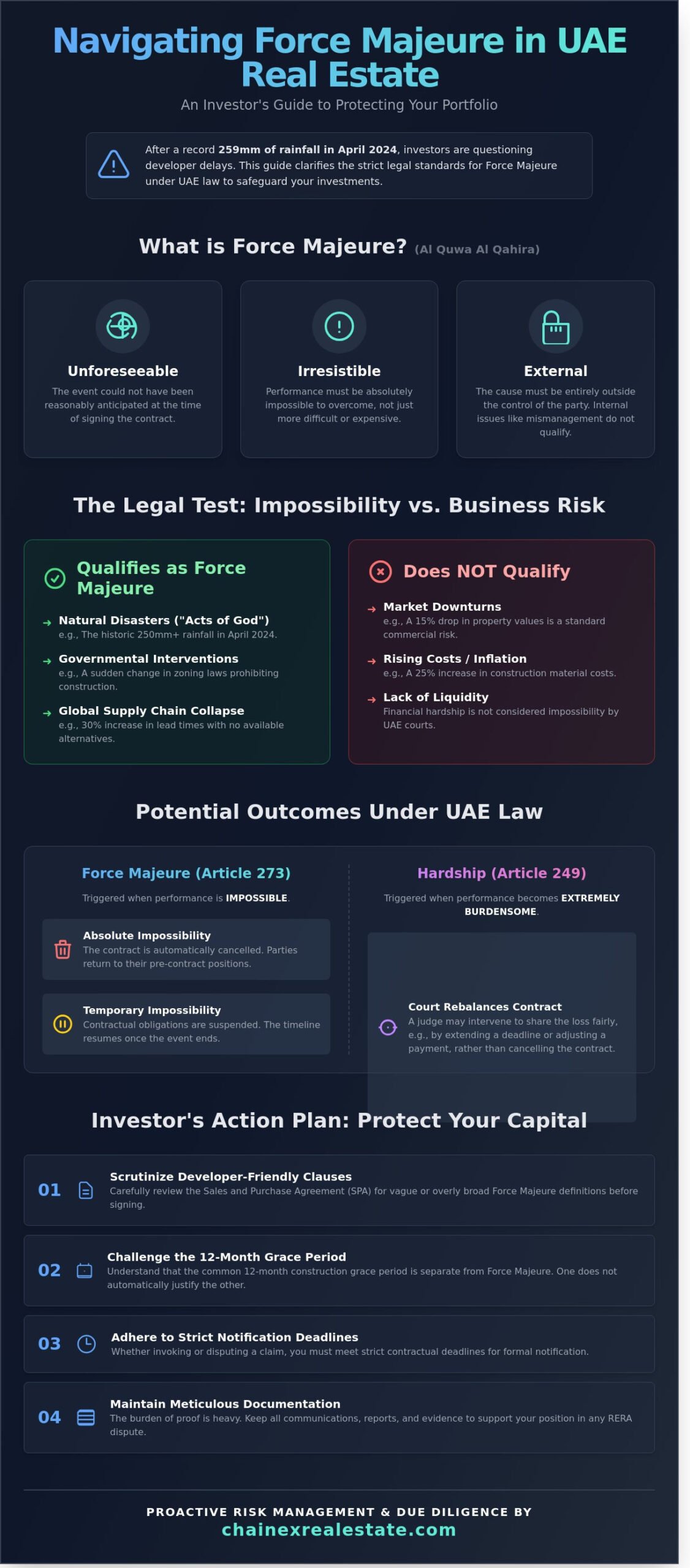
In the legal framework of the United Arab Emirates, specifically under the Civil Code, force majeure refers to an external, unpredictable event that makes the performance of a contractual obligation physically or legally impossible. Often translated from the Arabic term “Al Quwa Al Qahira,” it represents a “superior force” that overrides the intentions of the parties involved. In the high-stakes environment of Dubai property investment, understanding Force majeure in Contract if when how it applies is vital for protecting your capital and managing expectations during project delays.
To successfully invoke a claim in a UAE court, a party must prove the existence of three specific pillars. These criteria ensure that the clause isn’t used as a convenient exit strategy for standard business risks. The event must be:
- Unforeseeable: The event couldn’t have been reasonably anticipated by an experienced professional at the time the contract was signed.
- Irresistible: It’s not enough for the event to be difficult; it must be impossible to overcome. If the obligation could’ve been met through alternative, albeit more expensive, means, the claim will likely fail.
- External: The cause must be entirely outside the control of the party seeking relief. Internal strikes, equipment failure, or mismanagement don’t qualify.
It’s vital to distinguish between genuine impossibility and mere financial hardship. Dubai courts have established a firm precedent that market downturns, such as a 15% drop in property values, or a sudden lack of liquidity don’t constitute force majeure. Even if construction costs for a villa in Emirates Hills rise by 25% due to global inflation, the developer’s obligation to deliver remains legally binding. The law views these as inherent commercial risks that a sophisticated investor or builder should’ve factored into their strategy.
Property law in the UAE also differentiates between “Absolute” and “Temporary” impossibility. Under Article 273 of the Civil Code, if an event makes performance permanently impossible, the contract is automatically cancelled, and parties are restored to their original positions. However, if the impossibility is temporary, such as a short-term suspension of work due to an emergency decree, the obligations are usually only suspended. Once the event passes, the clock starts ticking again, and the parties must resume their duties immediately.
Common Force Majeure Events in Dubai
The historic rainfall of April 16, 2024, where Dubai received over 250mm of rain in a single day, serves as a clear example of a natural disaster that can trigger these clauses. Such “Acts of God” physically prevent work on-site and are entirely outside human control. Governmental interventions also qualify; for example, if a relevant regulatory authority issues a sudden change in zoning that prohibits a planned 50-story tower, the contract becomes legally impossible to fulfill. Additionally, global supply chain collapses, like the 30% increase in lead times for specialized glass or steel seen in 2021, may be considered if no local alternatives exist.
Force Majeure vs. Hardship (Imprévision)
While force majeure focuses on impossibility, Article 249 of the UAE Civil Code introduces the concept of “exceptional circumstances” or hardship. This applies when an event makes a contract’s performance extremely burdensome, though not technically impossible. In such scenarios, the Dubai courts play a proactive role in “rebalancing” the contract. Rather than terminating the agreement, a judge might reduce a tenant’s rent or extend a developer’s deadline to ensure the loss is shared fairly. Knowing Force majeure in Contract if when how these legal nuances interact allows investors to navigate complex disputes with the confidence that the UAE legal system prioritizes equity and the continuity of business.
The Legal Threshold: When Does an Event Qualify Under UAE Law?
The UAE Civil Code establishes a high bar for what constitutes an “external cause” or force majeure. Under Article 273, the court distinguishes between total and partial impossibility. If an unforeseen event makes the entire contract impossible to perform, the obligation is extinguished and the contract is rescinded by law. However, if the impossibility is only partial, only that specific portion of the obligation is affected. For a real estate investor in Dubai, this might mean a delay in a specific construction phase rather than a total cancellation of the Sales and Purchase Agreement (SPA). The court’s primary focus is whether the contract can still be saved or if the foundation of the agreement has crumbled.
Proving force majeure in Contract if when how it applies requires the claiming party to carry the heavy weight of evidence. You can’t simply point to a difficult market or a rise in material costs. You must prove the event was “irresistible” and “unforeseeable” at the time of signing. Courts often apply the ‘Reasonable Person’ test; they ask if a prudent developer or contractor could’ve taken steps to mitigate the damage. For instance, during the record-breaking rainfall on April 16, 2024, which saw nearly 250mm of rain in 24 hours, parties had to prove that even with standard drainage and site preparation, the damage was unavoidable.
Causality is the final, and perhaps most difficult, hurdle. The event must be the direct and sole reason for the breach. If a project was already 180 days behind schedule due to poor management before a regional crisis occurred, the court may reject the claim. Geopolitical shocks and force majeure events are often cited in the Middle East, but they only provide relief if they directly stop the supply chain or labor movement essential to your specific project. Without this direct link, the obligation remains binding.
Key UAE Civil Code Articles for Investors
Understanding the specific legal anchors is vital for any serious investor. Article 273 is the foundation, dictating that if performance becomes impossible, the contract is cancelled and parties are returned to their original positions. Article 287 shields a party from paying damages if they prove the loss resulted from an external cause, such as a natural disaster. Finally, Article 473 focuses on the extinguishment of the obligation itself, a vital tool for those seeking to exit a contract without penalty when performance is truly out of reach.
Documenting the ‘Irresistible’ Event
Professionalism in these moments requires meticulous record-keeping. You’ll need official reports from the National Center of Meteorology (NCM) or specific government decrees to validate the event’s scale. In the construction sector, the ‘Notice of Delay’ is your most important shield. It must be issued within the specific timeframe mentioned in your contract, often 28 days under standard FIDIC-based forms used in the UAE. Failure to provide this notice can often waive your right to claim relief later.
Technical experts or legal specialists are often brought in to provide testimony on whether the event met the legal threshold. They analyze if the disruption was truly outside the party’s control or if it was a manageable risk. If you’re managing a complex portfolio, having a strategic partner to review your contractual risks can prevent these legal hurdles from becoming financial losses. This proactive approach ensures that your investments are protected by more than just hope; they’re protected by precise legal strategy.
Force Majeure in Off-Plan Contracts: Delays and Developer Obligations
Off-plan investments in Dubai require a sharp eye for detail. When you sign a Sale and Purchase Agreement (SPA), you’re often looking at a completion date several years away. Developers frequently draft these documents to protect their interests during unforeseen events. Understanding force majeure in Contract if when how it impacts your timeline is vital for protecting your capital. It’s the difference between a secured asset and a stuck investment.
Most SPAs include a 12-month grace period. This isn’t a force majeure event. It’s a standard buffer for minor logistical hurdles. A developer can only stop work without paying liquidated damages if they prove a genuine force majeure event, like a global pandemic or a change in UAE law that halts construction entirely. If a developer fails to deliver after this 12-month window without a valid legal excuse, they’re typically liable to pay you compensation, often calculated as a percentage of the purchase price, such as 5% to 7% per annum.
Analyzing the Sale and Purchase Agreement (SPA)
Standard contracts often try to label “shortage of materials” or “subcontractor insolvency” as force majeure. Under UAE Law, specifically Article 273 of the Civil Code, these are usually considered commercial risks, not external impossibilities. You should check if your SPA links the Escrow account to specific milestones. If a project is suspended for force majeure, the Dubai Land Department (DLD) often freezes Escrow disbursements. This ensures your funds, which must be held in AED, remain protected until work resumes. Don’t accept vague definitions; force majeure must be an unpredictable, external event that makes performance impossible, not just more expensive.
The Role of DLD and RERA
The Dubai Land Department acts as a shield for investors. If a developer claims force majeure, RERA investigates the site’s actual progress. If the project’s completion rate is below 60 percent and progress has ceased for over 6 months without a valid legal excuse, the buyer may have grounds for termination. You can’t just walk away; you must follow a specific legal path. Understanding force majeure in Contract if when how it applies to your specific unit is the first step before filing a case through the Rental Dispute Center (RDC) or Dubai Courts.
Seeking a refund involves several structured steps:
- Review the Project Status: Check the official RERA project tracker for the “Project Status” and “Percentage of Completion.”
- Formal Notice: Send a legal notice to the developer through a registered notary public, demanding a refund or a firm completion date.
- DLD Mediation: Attempt to resolve the dispute through the DLD’s mediation portal before escalating to litigation.
- Court Filing: If mediation fails, file a case with the Dubai Courts to terminate the contract and recover your full investment plus interest.
The legal landscape in Dubai is designed to be fair. While developers have protections for genuine disasters, they don’t have a license to delay indefinitely. By staying informed about your rights and the specific clauses in your SPA, you ensure that your investment journey remains professional and secure. A well-structured contract is your best defense against unexpected delays.
How to Invoke or Dispute a Force Majeure Claim: A Step-by-Step Framework
Invoking a clause isn’t a simple exit strategy. It’s a structured legal process that requires precision. In the UAE, the burden of proof lies heavily on the party claiming the excuse. Understanding Force majeure in Contract if when how to apply it effectively protects your capital from being tied up in endless litigation. To maintain the integrity of your investment portfolio, you must follow a disciplined five-step sequence.
- Step 1: Immediate Notification. You must act quickly. Most Dubai real estate contracts mandate a notice period of 5 to 14 days from the event’s start. If you miss this window, you may waive your right to claim relief entirely.
- Step 2: Mitigation Efforts. You’re legally required to minimize the damage. If a supplier fails, you must prove you searched for alternatives. UAE courts look for “reasonable diligence” before granting any exemptions.
- Step 3: Formal Documentation. Build a “Force Majeure File.” This should include government decrees, weather reports from the National Centre of Meteorology, and internal logs showing the direct impact on your obligations.
- Step 4: Negotiation and Settlement. Most disputes in the UAE are resolved through professional mediation. Finding a middle ground saves you the 5% to 10% legal fees typically associated with full-scale court battles.
- Step 5: Legal Escalation. When negotiations stall, the Dubai International Arbitration Centre (DIAC) is the standard venue for resolution. Their rulings are binding and recognized across the Emirates.
Sending the Formal Notice
A valid notice must be specific. It should cite the exact contract clause, describe the event in detail, and estimate the delay duration. Avoid vague language. Common mistakes include sending notices via WhatsApp or standard email without a delivery receipt. In the UAE, you should use registered mail through Emirates Post or a reputable courier like Aramex to ensure you have a verifiable paper trail for the court.
Disputing a Developer’s Claim
Investors often face developers who use minor disruptions to mask major project mismanagement. To challenge this, you must analyze the Dubai Land Department (DLD) construction progress reports. If a project was already 180 days behind schedule before a storm occurred, the developer cannot legally blame the weather for the entire delay. You can leverage “Liquidated Damages” clauses to demand compensation for the pre-existing delays that occurred before the force majeure event took place.
Our team provides the strategic oversight needed to protect your assets during complex contractual disputes. If you’re facing a delay or a claim, let us help you find a tailored solution for your property portfolio today.
The 2024 flooding events in Dubai served as a massive test for these frameworks. Data from recent tribunal hearings suggests that parties with comprehensive documentation were 40% more likely to reach a favorable settlement than those who relied on verbal agreements. Precision in documentation isn’t just a formality; it’s your primary defense. Whether you’re a buyer or a seller, the way you handle the first 72 hours of a disruptive event defines your legal standing for the next two years.
Strategic Risk Management: How Chainex Protects Your Real Estate Portfolio
Protecting a multi-million AED investment in Dubai’s fast-moving market requires more than just market intuition; it demands a clinical approach to risk mitigation. At Chainex, we don’t view property acquisition as a simple transaction. We treat it as a long-term strategic partnership where your capital’s safety is the primary metric of our success. Our framework for risk management focuses on identifying vulnerabilities before they manifest as financial losses, ensuring your portfolio remains resilient even when the unexpected occurs.
Our due diligence process begins long before you see a floor plan. We conduct exhaustive background checks on developers, focusing on their historical performance during market downturns or regional crises. We analyze RERA project status reports and verify that all payments are linked to DLD-approved escrow accounts. If a developer has a track record of delaying handovers by more than 12 months without providing clear, legally backed justifications, we flag the project as high-risk. This data-driven vetting ensures you only engage with entities that possess the financial liquidity to weather economic shifts.
The core of our protective strategy lies in the technical analysis of the Sales and Purchase Agreement (SPA). We meticulously examine the Force majeure in Contract if when how triggers to ensure they aren’t weaponized against the buyer. Many standard contracts in the UAE contain broad language that attempts to shield developers from penalties for delays that are actually manageable. We look for specific definitions. We ensure that events like “fluctuations in material costs” or “standard supply chain issues” aren’t incorrectly classified as force majeure. By narrowing these definitions, we keep the developer accountable for their original timeline.
Dubai’s regulatory environment is sophisticated, yet it requires constant monitoring. The record-breaking rainfall in April 2024 served as a major case study for the industry. It tested the limits of Article 273 of the UAE Civil Code regarding “impossibility of performance.” Our team analyzed how different developers responded to this event, distinguishing those who used it as a legitimate reason for a short suspension from those who used it to mask pre-existing structural delays. We provide this level of market intelligence so you can anticipate how environmental or regulatory changes might impact your specific assets.
The Chainex Approach to Secure Investing
We prioritize partnerships with developers who maintain robust insurance portfolios and significant cash reserves. Our network includes top-tier legal experts specializing in Dubai property law who review every clause for “red flag” language. In 2023, we successfully assisted a client in the Business Bay area whose project faced a 16-month suspension. By identifying that the developer’s claim of force majeure didn’t meet the “unforeseeable” criteria under UAE law, we negotiated a structured compensation plan that preserved the client’s ROI. We act as your strategic shield, ensuring that the Force majeure in Contract if when how details are always skewed in favor of transparency and fairness.
Next Steps for Investors
Securing your future starts with a proactive audit of your current and planned commitments. You shouldn’t wait for a construction stoppage to understand your legal standing. We recommend reviewing your existing portfolio for force majeure exposure immediately, especially for off-plan assets. If you’re considering a new acquisition, the most critical step is professional intervention during the cooling-off period. You can Book a strategic investment consultation with Chainex Real Estate to have our experts evaluate your SPA and ensure your investment is anchored in security, not just speculation.
Securing Your Dubai Real Estate Portfolio Against Unforeseen Disruptions
Navigating the legal intricacies of Force majeure in Contract if when how requires more than a basic understanding of the UAE Civil Code. It demands a sophisticated approach to risk management, particularly for high-value assets in Dubai Marina and Palm Jumeirah. Our expert market analysis for 2026 indicates that precise contract drafting is the primary safeguard for your capital. You now understand that a successful claim depends on proving an event was both unavoidable and external to the parties involved. Because the Dubai property market moves quickly, having a partner who manages these complexities is essential. Chainex maintains strategic partnerships with leading UAE financial institutions to ensure every transaction remains secure and transparent. We don’t just facilitate sales; we provide a professional framework that protects your long-term interests. Your journey toward a resilient investment starts with the right technical oversight. Secure your Dubai property investment with expert guidance from Chainex. We’re ready to help you build a legacy of stability in the world’s most dynamic market.
Frequently Asked Questions
Is a pandemic like COVID-19 still considered force majeure in 2026?
In 2026, COVID-19 isn’t typically considered a force majeure event because it’s no longer an unpredictable occurrence. UAE courts and Article 273 of the Civil Code require events to be unforeseen at the time of signing. Since the global pandemic began in March 2020, parties signing contracts in 2026 are expected to account for such risks. If you sign a deal now, you’re accepting the current health landscape as a known factor rather than an Act of God.
Can I stop my mortgage payments if the developer invokes force majeure?
You cannot stop your mortgage payments even if a developer invokes a force majeure clause to delay construction. Your loan agreement with the bank is a distinct legal contract from your Sales and Purchase Agreement (SPA) with the developer. While the developer might legally pause work for 180 days without penalty, your obligation to the bank remains active. Failing to pay could result in late fees starting from 1% or legal action under UAE mortgage laws.
What happens if a property is destroyed by a natural disaster before handover?
If a property is destroyed before handover, Article 273 of the UAE Civil Code generally dictates that the contract becomes rescinded and the parties return to their original positions. The developer must return all paid installments to the buyer. Since the risk of loss only transfers to the owner upon the official handover and registration of the title deed, the developer bears the financial burden of the physical loss. This protects your capital if a storm or fire ruins the structure before you take possession.
Does unprecedented rainfall in Dubai count as a force majeure event?
Record breaking rainfall, such as the 250mm of rain that fell in Dubai on April 16, 2024, can qualify as force majeure if it makes performance impossible. For rainfall to count, it must exceed historical weather patterns and be classified as an extraordinary event by local authorities. Developers often use these events to justify 30 to 60 day extensions. It’s vital to understand force majeure in contract if when how it applies to specific weather disruptions in the Emirates to protect your timeline.
How long does a developer have to restart work after a force majeure event ends?
Most UAE contracts require a developer to resume work immediately once the force majeure event ceases to exist. While the law doesn’t set a universal number of days, standard industry practice dictates a restart within 14 to 30 days of the situation stabilizing. If a developer fails to mobilize their crew after the site is cleared of floodwater or debris, they risk losing their legal protection against delay claims. We recommend monitoring site activity closely 14 days after the event concludes.
Can I get a full refund of my Oqood and deposit if a project is canceled due to force majeure?
You’re entitled to a full refund of your deposit and Oqood fees if a project is officially canceled by the Dubai Land Department (DLD) due to force majeure. Under Executive Council Resolution No. 6 of 2010, the developer must refund the 4% Oqood fee and all paid amounts within a specific timeframe, often 60 days. This ensures that investors aren’t penalized for external events that make the 50 story tower or villa community impossible to complete.
Is a change in UAE law or tax (like VAT) considered a force majeure event?
A change in UAE law or the introduction of a tax like the 5% VAT isn’t usually a force majeure event. These are considered hardship or change in law issues rather than events that make performance physically impossible. Unless the new regulation specifically prohibits the construction or sale of the property, you’re still bound by the original price and terms. Understanding force majeure in contract if when how helps distinguish between a more expensive deal and a legally impossible one.
What is the difference between force majeure and a Material Adverse Change (MAC) clause?
Force majeure focuses on events that make fulfilling the contract impossible, like a war or a major earthquake. A Material Adverse Change (MAC) clause is different; it allows a party to withdraw if there’s a significant drop in the other party’s financial health or the asset’s value. While force majeure might pause a project for 90 days, a MAC clause is often used by lenders to cancel a loan if the borrower’s income drops by 30% or more. Both serve to mitigate risk but trigger under very different circumstances.
