



What if the greatest risk in Dubai’s vibrant property market isn’t project delays, but rather missing the strategic window of opportunity that 2026 presents? It’s a valid concern for any discerning investor. The landscape is filled with dazzling marketing, complex payment structures, and the persistent question of how to distinguish genuine value from developer hype, making even seasoned buyers pause.
This guide is engineered to provide clarity and confidence. Here, we will equip you with a definitive framework for mastering your off-plan property investment UAE strategy, focusing on achieving significant capital appreciation before handover and securing payment terms that preserve your liquidity. You won’t just learn to invest; you’ll learn how to structure a high-yield portfolio with a clear, profitable exit strategy for the 2027-2030 horizon. We’ll deconstruct the latest regulatory updates, analyze emerging high-growth locations, and reveal the due diligence criteria that separate a standard purchase from a strategic acquisition.
Key Takeaways
- Learn to identify the optimal exit point for a ‘Buy-to-Flip’ strategy and how to effectively transition your asset into a high-yield rental property for 2028-2030.
- Understand how the UAE’s regulatory framework, including RERA oversight and mandatory Escrow accounts, provides robust protection for your capital against developer risks.
- Discover the strategic advantages of Post-Handover Payment Plans (PHPPs) and how they are reshaping off-plan property investment UAE for savvy investors in 2026.
- Gain insight into the market shift towards sustainable and smart-city projects to position your portfolio for maximum long-term capital appreciation.
What is Off-Plan Property Investment in the UAE?
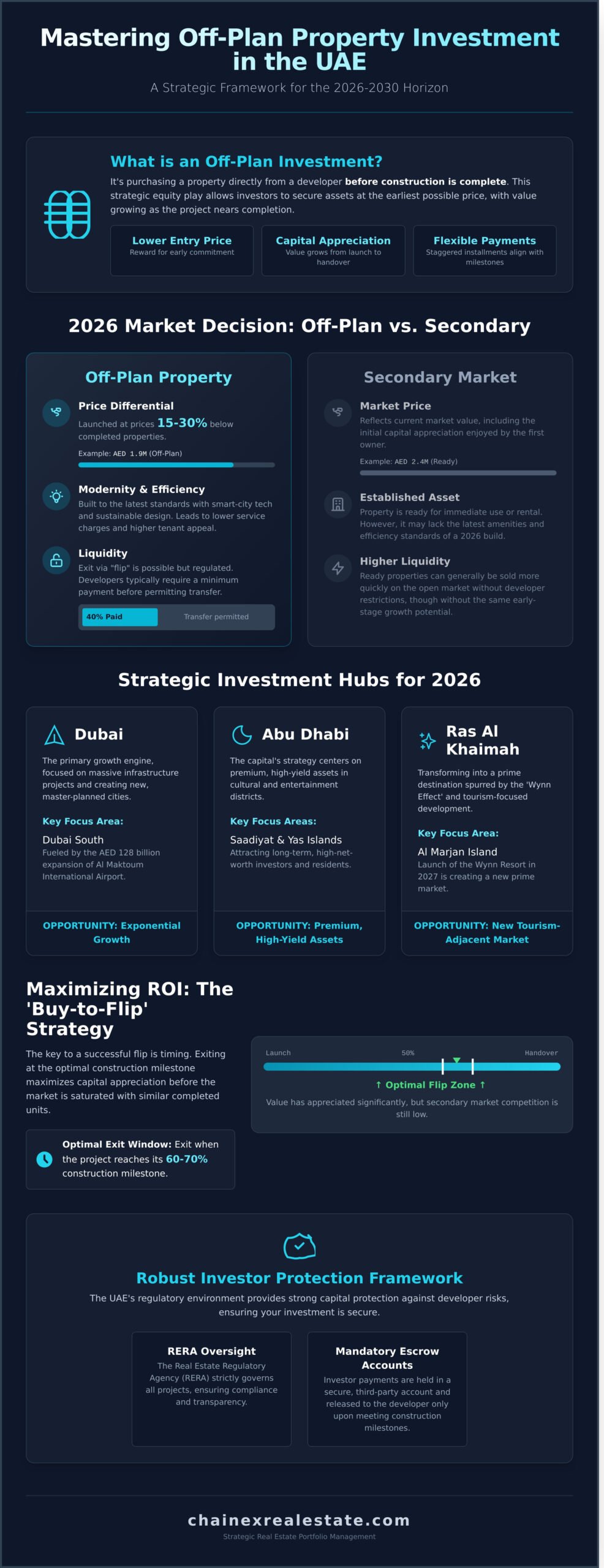
At its core, an off-plan property investment in the UAE involves purchasing a residential or commercial unit directly from a developer before construction is complete. This strategy allows investors to secure assets at the earliest possible stage, often based on architectural plans and 3D renderings. The fundamental concept, as detailed in this overview of What is Off-Plan Property, is built on the principle of acquiring an asset at a competitive price point with the expectation of significant capital appreciation upon completion. Investors typically benefit from flexible, staggered payment plans, committing capital in installments that align with construction milestones rather than requiring a single, substantial upfront payment.
Looking toward 2026, the UAE market is evolving beyond sheer architectural ambition. The new wave of projects is deeply integrated with national strategies like the Dubai 2040 Urban Master Plan. Developers are now prioritizing sustainability, with many new builds targeting high Al Sa’fat or LEED ratings, and smart-city technology. This means investors aren’t just buying a property; they’re buying into a future-proofed, interconnected community designed for efficiency and a higher quality of life.
At Chainex Real Estate, we guide our clients to view this process not as a simple purchase, but as a strategic equity play. You are investing in a developer’s vision and the future economic trajectory of a specific district. The initial lower entry price is your reward for committing early, and the growth in value between the launch and handover is your return on that strategic foresight. It’s a calculated move to build wealth, timed to coincide with the UAE’s continued infrastructural and economic expansion.
Off-Plan vs. Secondary Market in 2026
The decision between an off-plan unit and a ready property on the secondary market hinges on three key factors:
- Price Differentials: Off-plan properties consistently launch at prices 15-30% below their completed counterparts. For instance, a two-bedroom apartment in a new development in a prime area like Dubai Creek Harbour might launch at AED 1.9 million, while a similar ready unit in a nearby tower could be listed for AED 2.4 million or more.
- Modernity and Efficiency: A property completed in 2026 will be built to the latest construction and energy-efficiency standards. This translates to lower service charges, better amenities, and higher appeal for tenants who prioritize modern, sustainable living.
- Liquidity: Exiting an off-plan contract, known as an assignment sale or “flip,” is possible but regulated. Most developers require at least 40% of the property value to be paid before permitting a transfer. This makes it less liquid than the secondary market, where a ready property can be sold more quickly, albeit without the same potential for early-stage capital growth.
Key Investment Hubs: Dubai, Abu Dhabi, and Ras Al Khaimah
Strategic location is paramount for a successful off-plan property investment in the UAE. As of late 2024, three emirates present distinct opportunities:
- Dubai: While established areas like Business Bay continue to offer strong rental yields, the primary growth engine is Dubai South. Fueled by the AED 128 billion expansion of Al Maktoum International Airport, this master-planned city is poised for exponential growth.
- Abu Dhabi: The capital focuses on premium, high-yield assets. Saadiyat Island, with its world-class cultural district, and Yas Island, an entertainment and leisure hub, offer off-plan villas and apartments that attract long-term, high-net-worth investors and residents.
- Ras Al Khaimah (RAK): The ‘Wynn Effect’ is transforming RAK’s investment landscape. The impending 2027 launch of the Wynn Al Marjan Island, a multi-billion-dirham integrated resort, has spurred a wave of luxury off-plan projects from top-tier developers, creating a new prime market for gaming- and tourism-adjacent real estate.
Maximizing ROI: Capital Appreciation and Yield Strategies
A successful off-plan property investment UAE strategy is built on a clear understanding of its two primary return generators: capital appreciation and rental yield. Capital appreciation in the 2026 UAE market is the anticipated increase in a property’s market value, driven by sustained economic demand, strategic government initiatives, and the completion of city-wide infrastructure projects. Your investment timeline and financial objectives will determine which of the following sophisticated strategies aligns best with your portfolio.
The ‘Buy-to-Flip’ model remains a potent strategy for investors seeking shorter-term gains. The critical decision here is timing. Exiting the investment when the project reaches its 60-70% construction milestone is often the optimal window. At this stage, the property’s value has typically seen significant appreciation from its launch price, yet the final, larger installment payments are not yet due. This maximizes your cash-on-cash return and attracts secondary market buyers who can now visualize the finished product without undertaking the earliest construction phase risks.
Alternatively, the ‘Buy-to-Let’ model focuses on long-term income generation. For projects completing between 2028 and 2030, investors are positioning themselves to capitalize on a mature rental market. Projections indicate that high-demand communities could deliver gross rental yields between 6-9% annually. Furthermore, forward-thinking investors analyze infrastructure-led growth, predicting value spikes based on urban expansion. For instance, properties located along the planned Dubai Metro Blue Line route are poised for substantial appreciation as connectivity improves accessibility to key business and leisure hubs.
The Golden Visa and Off-Plan Investment
The UAE’s 10-year Golden Visa program adds a significant lifestyle incentive to property investment. An off-plan property purchase qualifies for this long-term residency, provided its value is at least 2 million AED. Eligibility for the visa application is typically granted once the investor has a Sale and Purchase Agreement (SPA) for a property meeting this value threshold with an approved developer. This long-term visa provides unparalleled stability for international families, facilitating seamless integration into the UAE’s world-class education and healthcare systems.
Calculating Your Net ROI
A precise calculation of your net return on investment must account for all associated costs. This begins with the standard 4% Dubai Land Department (DLD) registration fee and nominal administrative fees, which should be factored into your initial outlay. Projected appreciation rates vary significantly by location; a prime, established area like Dubai Marina may see stable appreciation of 5-7% annually, whereas an emerging community such as Jumeirah Village Circle (JVC) could experience higher growth of 10-14% as new infrastructure is completed. The structure of your payment plan has a profound impact on returns. Post-handover payment plans, for example, can significantly boost your internal rate of return (IRR) by allowing you to generate rental income while still servicing payments to the developer. Understanding these financial nuances is essential for Maximizing ROI and ensuring your investment aligns with forward-looking regulations. Crafting a strategy that balances these variables is complex, which is why our advisors specialize in creating detailed portfolio projections tailored to your financial goals.
Risk Mitigation: Navigating the 2026 Regulatory Framework
An astute investment is defined not by its potential returns, but by its managed risks. The UAE, particularly Dubai, has engineered one of the world’s most robust regulatory environments to safeguard investor capital. This framework, spearheaded by the Real Estate Regulatory Agency (RERA), transforms a speculative venture into a calculated strategic decision.
RERA’s oversight is comprehensive. It begins before a single brick is laid, with stringent approvals for project plans, marketing materials, and financial viability. The cornerstone of investor protection is Law No. (8) of 2007, which mandates the use of Escrow Accounts. Your payments are not transferred directly to the developer. Instead, they are held in a third-party, RERA-approved bank account. Funds are only released to the developer upon reaching verified construction milestones, a system that effectively insulates your capital from developer insolvency or mismanagement.
The most common concern for investors is project delay or cancellation. RERA provides a clear legal path. If a project is officially cancelled by the authorities, investors are legally entitled to a full refund from the escrow account. For significant delays, the Sale and Purchase Agreement (SPA) outlines specific compensation clauses. This structured recourse is a fundamental strength of any off-plan property investment UAE strategy, providing a level of security rarely seen in emerging markets.
The Importance of the Oqood
The Oqood, meaning “contract” in Arabic, is your first official step towards legal ownership. It is an initial registration of your off-plan property with the Dubai Land Department (DLD). This process formally records your interest in the property, preventing the developer from selling the same unit to another party. The Oqood serves as a pre-title deed, securing your rights until the final Title Deed is issued upon project completion and handover.
Vetting Developers in 2026
Your primary risk mitigation tool is selecting the right developer. This involves a strategic choice between established Tier 1 developers and specialized Boutique firms. Tier 1 developers like Emaar Properties boast completion rates often exceeding 95% on schedule, offering unmatched security. Boutique developers may present opportunities for higher capital appreciation, but demand more rigorous due diligence. We advise clients to analyse key performance indicators:
- On-Time Handover Record: A history of delivering projects within the promised timeframe is the most critical metric.
- Quality of Finish: Examine completed projects from the developer to assess their commitment to quality construction and materials.
- Construction Progress Tracking: Utilize the DLD’s official ‘Dubai REST’ application to monitor real-time, verified construction percentages for any project.
While digital tools provide excellent data, a physical site visit remains indispensable. Observing the activity level, organisation, and quality of work on the ground provides an intangible but vital layer of assurance for your investment.
Understanding 2026 Payment Plans and Exit Strategies
A successful off-plan property investment UAE strategy is built on two pillars: a deep understanding of developer payment structures and a meticulously planned exit. As we move into 2026, the market is evolving beyond traditional models, offering investors greater flexibility but also demanding more strategic foresight. The key isn’t just acquiring a property; it’s about structuring the purchase to align perfectly with your financial goals, whether that’s long-term rental income or a profitable short-term resale.
Historically, the dominant model has been the ‘Construction-Linked’ plan, such as a 60/40 or 50/50 split, where the bulk of the payments are made during the construction phase, culminating in a substantial final payment upon handover. However, a significant trend for 2026 is the increasing prevalence of the ‘Post-Handover Payment Plan’ (PHPP). These innovative plans might still follow a 60/40 structure, but the final 40% is spread over two to five years after you’ve received the keys. This allows investors to generate rental income from the property to help cover the remaining instalments, fundamentally altering the cash flow dynamics.
For investors focused on capital appreciation through resale, or ‘flipping’, the payment plan is even more critical. The objective is to secure a unit, benefit from the market’s upward trajectory during construction, and sell before the large final handover payment is due. Crucially, once 40% of the property’s value is paid, Dubai Land Department regulations permit the original buyer to resell the unit on the secondary market, transferring the Sale and Purchase Agreement to a new owner.
Popular Payment Plan Structures
Developers in Dubai and Abu Dhabi offer a diverse range of payment plans designed to attract different investor profiles. Understanding these is the first step toward portfolio optimization.
- 10% Down Payment: This structure significantly lowers the barrier to entry, allowing investors to secure premium units in highly anticipated projects with minimal initial capital outlay. It’s a powerful tool for diversifying a portfolio across multiple assets.
- 1% Monthly Plans: Popularised by major developers for mid-market projects, these plans cater to retail investors and salaried professionals. By breaking down payments into manageable monthly instalments of 1%, they preserve an investor’s cash flow for other opportunities.
- Bullet Payments: These plans involve larger, periodic payments, such as 10% every six months. They are ideally suited for investors who align their capital deployment with predictable liquidity events like annual corporate bonuses or investment dividend payouts.
Executing the Flip: A Step-by-Step Guide
A well-executed flip can yield substantial returns, but it requires precise timing and adherence to regulatory processes. The process is straightforward when managed by a professional.
- Reaching the Resale Threshold: The first legal requirement is to meet the developer’s minimum payment threshold for resale. While the DLD’s baseline is 40%, developers can stipulate a higher percentage in the Sale and Purchase Agreement (SPA). Verifying this clause is a critical part of due diligence.
- Obtaining the No Objection Certificate (NOC): Once the payment threshold is met, you must apply to the developer for an NOC. This document formally grants you permission to sell the property. Developers typically charge an administrative fee for this service, usually ranging from 1,000 AED to 5,000 AED.
- Marketing to the Secondary Market: Your unit is now an attractive proposition for a different type of buyer: one looking for a brand-new, ‘near-ready’ home without waiting through the entire 2-3 year construction period. You are selling them proximity to completion, a tangible asset they can soon inhabit.
Navigating payment milestones and the resale process requires precision and deep market insight. Consult with a Chainex expert to structure your exit strategy and ensure your investment journey is seamless and profitable.
Building Your Portfolio with Chainex Real Estate
Successfully navigating the dynamic world of off-plan property investment in the UAE requires more than access to listings; it demands a strategic partnership. At Chainex Real Estate, we move beyond the transactional role of a broker to become your dedicated portfolio advisors. Our philosophy, the ‘Chainex-Approach’, is built on a foundation of transparency, rigorous data analysis, and a commitment to your long-term financial growth. We don’t just find you a property; we co-author your investment success story.
This partnership begins with personalized investment consulting. We take the time to understand your unique objectives, whether you’re seeking high rental yields, substantial capital appreciation, or a balanced portfolio for generational wealth. Our service extends from the initial strategy session to complete, full-cycle management. We handle every detail, from the meticulous review of the Sales and Purchase Agreement (SPA) to providing consistent construction updates and managing your asset post-handover, ensuring a seamless and secure experience.
Our established relationships with the UAE’s most reputable developers, including Emaar, Sobha, and DAMAC, provide our clients with a distinct advantage. We secure exclusive, early-bird access to high-demand project launches, often gaining allocation for prime units days before they are released to the general public. This priority access is crucial in a market where the best properties are sold within hours.
Our 2026 Off-Plan Selection Criteria
Our recommendations are the product of a stringent, multi-layered vetting process designed to protect your capital and maximize returns. We only endorse projects that meet our exacting standards:
- Strict Developer Vetting: We exclusively partner with developers who have a proven track record of on-time delivery and quality construction. A non-negotiable requirement is a RERA-approved and fully secured escrow account for every project, safeguarding your investment capital.
- Proactive Location Scouting: Our in-house analysts use predictive data models, tracking infrastructure development and demographic shifts to identify the communities poised for exponential growth. We look for the next Business Bay or Dubai Hills, securing opportunities before they become mainstream.
- ROI Stress-Testing: Every potential investment is subjected to rigorous financial modeling. We analyze ‘worst-case’ scenarios, such as a temporary 15% dip in market rental rates or increased service charges, to ensure your selected property demonstrates resilience and viability under pressure.
Start Your UAE Investment Journey Today
Your journey into the lucrative market of off-plan property investment UAE starts with a simple conversation. We invite you to book a complimentary, no-obligation consultation with one of our senior property advisors. These can be conducted virtually for our international clients or in person at our state-of-the-art office in Business Bay, Dubai. We specialize in creating customized portfolio reports that align with your financial goals, providing a clear roadmap for your investments. Let us show you how strategic, data-driven decisions can unlock unparalleled growth. Contact Chainex Real Estate for a tailored market analysis and begin building your legacy in the UAE.
Chart Your Course for 2026 Property Success
The path to maximizing returns in the Emirates’ dynamic real estate market is clear. Success in 2026 hinges on leveraging the robust regulatory framework overseen by RERA for investor protection and identifying projects from Tier 1 developers that offer both significant capital appreciation, often exceeding 25% upon completion, and flexible post-handover payment plans. A strategic approach to off-plan property investment UAE isn’t just about acquiring assets; it’s about building a secure and profitable future portfolio.
Don’t navigate this landscape alone. The expert consultants at Chainex Real Estate, from our headquarters in Clover Bay Tower, Business Bay, are ready to be your strategic partners. We provide comprehensive market analysis and precise ROI modeling, leveraging our exclusive partnerships with the UAE’s most reputable developers to grant you access to premier opportunities before they reach the public market. Let us craft a personalized strategy tailored to your financial ambitions.
Explore Exclusive 2026 Off-Plan Opportunities with Chainex and transform market potential into tangible wealth. Your premier property portfolio begins here.
Frequently Asked Questions: Off-Plan Property Investment UAE
Is buying off-plan property in the UAE safe in 2026?
Yes, buying off-plan property in the UAE is considered highly secure in 2026 due to stringent government regulations. Authorities like Dubai’s Real Estate Regulatory Agency (RERA) mandate that all developer payments are held in protected escrow accounts. This system, established under laws like Dubai’s Law No. 8 of 2007, ensures your funds are used exclusively for the construction of your specific project, providing a robust layer of financial protection for investors.
Can foreigners own 100% of off-plan property in Dubai?
Yes, foreign nationals are permitted to have 100% freehold ownership of off-plan properties within Dubai’s designated freehold zones. These areas, which include prominent communities like Dubai Marina, Downtown Dubai, and Palm Jumeirah, were legally established to encourage international investment. In these zones, non-GCC investors enjoy the same property rights as UAE citizens, including the right to sell, lease, or inherit their property without any restrictions.
What is the minimum down payment for off-plan property in the UAE?
The minimum down payment for an off-plan property typically ranges from 5% to 20% of the total purchase price. This initial amount is determined by the developer and the specific project’s payment plan. For example, a common structure involves a 10% booking fee, followed by scheduled installments throughout the construction phase. Your Sales and Purchase Agreement (SPA) will provide a detailed breakdown of the complete payment schedule required for your investment.
How do I sell my off-plan property before it is completed?
You can sell an off-plan property before its completion through a transaction known as an assignment sale or a “flip.” To proceed, you must first obtain a No Objection Certificate (NOC) from the developer. Most developers stipulate that a minimum percentage of the property’s value, usually between 30% and 50%, must be paid before they will issue an NOC. The sale must then be officially registered with the relevant land department to ensure its legal validity.
Does off-plan property investment qualify for the UAE Golden Visa?
Yes, an investment in off-plan property can qualify you for the 10-year UAE Golden Visa. To be eligible, the property’s value must be at least AED 2 million, a threshold that can be met with a single property or a portfolio of properties from approved developers. This makes a strategic off-plan property investment in the UAE an excellent pathway for securing long-term residency for yourself and your family while building your asset portfolio.
What happens if a developer misses the handover date in 2026?
If a developer misses the scheduled handover date, your investment is protected by the terms outlined in your Sales and Purchase Agreement (SPA). Contracts typically include a grace period, often up to 12 months, to account for potential construction delays. Should the delay extend beyond this period, you may be entitled to compensation as defined in your agreement. In severe cases, regulatory bodies like RERA can intervene to mediate or enforce penalties on your behalf.
Are there any hidden costs when buying off-plan in Dubai?
While not intentionally hidden, there are several standard ancillary costs to anticipate beyond the purchase price. The primary fee is the Dubai Land Department (DLD) registration, which is 4% of the property’s value. You should also budget for the Oqood registration fee, which is approximately AED 5,000, plus any administrative fees levied by the developer. Factoring these expenses into your budget is a crucial step for a successful off-plan property investment in the UAE.
Can I get a mortgage for an off-plan property in the UAE?
Yes, securing a mortgage for an off-plan property is possible, although the conditions differ from financing for a completed unit. Lenders in the UAE generally require a higher down payment for off-plan purchases, often 50% of the property’s value. Furthermore, banks will only provide financing for projects from a pre-approved list of developers. We advise consulting with a mortgage specialist early to confirm your eligibility and explore available financing options.
