


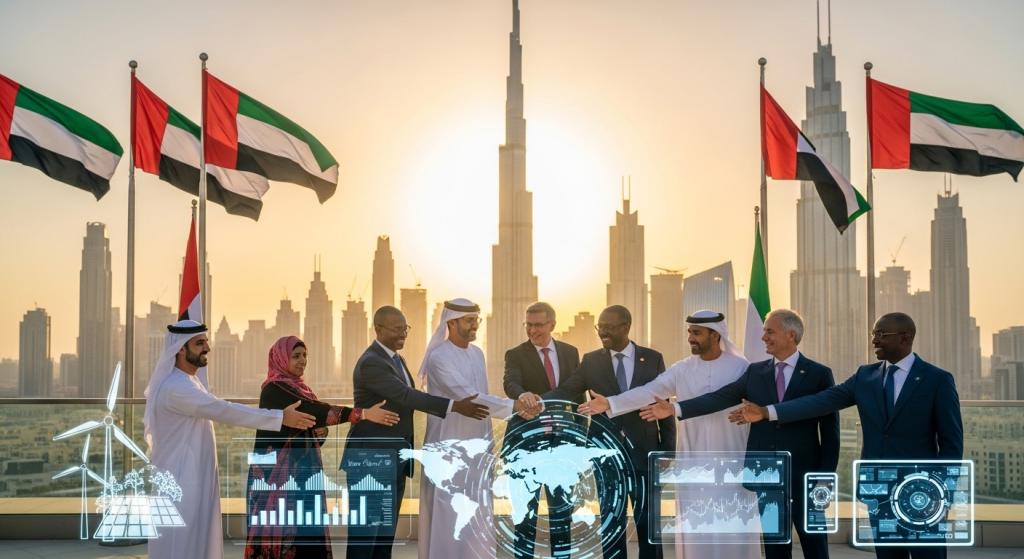
The UAE has quietly become one of the world’s most economically connected nations. Since September 2021, it has signed 27 Comprehensive Economic Partnership Agreements (CEPAs) — deals that cover trade, investment, digital commerce, and services with countries across Asia, Africa, Europe, and beyond.
For real estate investors, property buyers, and tenants in Dubai, this is not background noise. Every agreement the UAE signs with a foreign nation is a new engine of demand for the property market. More trade means more businesses. More businesses mean more professionals. More professionals mean more people who need somewhere to live, work, and invest.
This article breaks down exactly which agreements matter, what they cover, and what they mean for Dubai real estate in 2026 and beyond.
Table of Contents
1. What Is a CEPA? The Framework Explained
2. The UAE’s CEPA Programme: Scale and Speed
3. Key International Agreements Shaping 2026
4. The Africa Strategy: A Long-Term Play
5. What These Agreements Mean for Dubai Real Estate
6. The Golden Visa Connection
7. What to Watch in 2026 and Beyond
8. Conclusion: A Market Built on Connection
1. What Is a CEPA? The Framework Explained
A Comprehensive Economic Partnership Agreement (CEPA) is a bilateral free trade deal designed to go far beyond simply reducing tariffs. A CEPA is a full-spectrum economic alliance between two nations.
A typical CEPA between the UAE and a partner country covers:
- Reduction or elimination of tariffs on goods
- Market access for service industries
- Investment protection and promotion frameworks
- Digital trade and e-commerce rules
- Intellectual property rights
- Regulatory cooperation and customs simplification
- Rules of origin — determining which goods qualify for preferential treatment
Unlike a simple free trade agreement, a CEPA is built for depth. It creates the legal and commercial architecture for two economies to integrate at a structural level — not just to exchange goods cheaply, but to share investment, talent, and knowledge over the long term.
A CEPA does not just open a door between two economies. It builds an entire corridor — with rules, protections, and incentives that make cross-border business predictable and profitable for both sides.
2. The UAE’s CEPA Programme: Scale and Speed
The UAE launched its CEPA initiative in September 2021 under the “Projects of the 50” — a set of national development programmes designed to transform the country’s economy over the following five decades.
The pace of expansion has been remarkable:
| 27 CEPAs Concluded as of March 2026 — spanning Asia, Africa, Europe, and beyond |
| Dh3 Trillion UAE non-oil foreign trade in 2024 — a record high, up 14.6% year-on-year |
| Dh135 Billion CEPA contribution to UAE non-oil trade — a 42% increase year-on-year |
75% of the UAE’s Dh4 trillion trade target for 2031 had already been achieved by end of 2024 — putting the country years ahead of schedule. Sheikh Mohammed bin Rashid described this milestone as proof that “the pace will reach it years ahead of schedule.”
Which CEPAs Are Currently Active?
As of March 2026, the following CEPAs are fully operational:
| Country | In Effect Since | Trade Target |
| India | May 2022 | $50.5B non-oil trade achieved in year one |
| Israel | April 2023 | Target: $10B by end of decade (from $1.3B in 2021) |
| Indonesia | September 2023 | Target: $10B non-oil trade by 2027 |
| Turkey | 2023 | Target: $40B in trade by 2028 |
| Cambodia | January 2023 | Target: $1B by 2025–2027 |
| Georgia | June 2024 | Target: Triple non-oil trade to $1.5B within 5 years |
| Mauritius | April 2025 | First UAE–Africa CEPA to enter into force |
| Costa Rica | 2024 | Gateway into Central American markets |
| Serbia | 2024 | EU candidate state — strategic European bridge |
| Jordan | 2024 | Strengthening Arab regional trade corridors |
Signed But Pending Implementation
A second tier of CEPAs have been signed and are going through ratification or implementation processes:
- Malaysia — Signed January 2025. Target: 60% increase in bilateral trade over five years.
- New Zealand — Signed January 2025. 100% duty-free access for UAE imports.
- Kenya — Signed January 2025. Target: Trade beyond $3 billion.
- Ukraine — Signed February 2025. Near-full market access for Ukrainian goods.
- Chile, Colombia, Vietnam, Australia, South Korea — all signed, pending implementation.
- Azerbaijan — Signed 2025. Non-oil trade rose 43% year-on-year in 2024.
- Nigeria — Signed January 2026. Africa’s largest economy now in the UAE’s CEPA network.
3. Key International Agreements Shaping 2026
UAE – Japan CEPA
Concluded in early 2026, the UAE–Japan CEPA is Japan’s first-ever agreement with an Arab nation. This is a landmark not just for the UAE but for the entire region.
Non-oil bilateral trade between the two countries reached $20.3 billion in 2025 — a 16.7% increase over the previous year. The agreement focuses on:
- Advanced technology and innovation
- Logistics and supply chain resilience
- Cybersecurity and digital infrastructure
- Healthcare and education
- Energy security and green transition
The UAE is Japan’s primary trading partner across the entire Middle East and Africa region, accounting for 39% of Japan’s total trade volume with Arab and African nations combined.
UAE – European Union Free Trade Agreement
Formal negotiations between the UAE and the EU were launched on 28 May 2025. If concluded as planned by end of 2026, this would be the first-ever free trade agreement between the European Union and any Gulf country — a historic structural shift.
Key focus areas include:
- Artificial intelligence and digital trade
- Renewable energy and green hydrogen
- Critical raw materials
- Pharmaceutical and biomedical technologies
- Industrial equipment and manufacturing
The EU’s motivation is explicit: European Commission President Ursula von der Leyen described the UAE talks as part of a deliberate strategy to “de-risk our economies and diversify our supply chains” away from dependence on the US and China. For the UAE, a deal with the 27-nation EU bloc would open access to one of the world’s largest consumer markets.
UAE – United Kingdom
UK-UAE CEPA negotiations are in final drafting as of early 2026 and could reach conclusion during the year. The UK is a major source of real estate capital, professional talent, and institutional investment for Dubai. A concluded deal would deepen an already strong bilateral relationship that sees billions in cross-border investment annually.
4. The Africa Strategy: A Long-Term Play
Africa is perhaps the most underappreciated dimension of the UAE’s CEPA programme. With deals concluded or in progress with Mauritius, Kenya, Nigeria, the Central African Republic, the Republic of Congo, Rwanda, Ghana, South Africa, and Chad, the UAE is systematically building a trade and investment corridor connecting the Gulf with the world’s youngest and fastest-growing continent.
The strategic logic is clear:
- Africa will have the world’s largest workforce by 2040
- Africa’s middle class is growing at an accelerating rate
- Dubai is geographically positioned as the natural hub between Africa and Asia
- African entrepreneurs and investors increasingly use Dubai as their global base
Nigeria’s inclusion in the CEPA network in January 2026 is particularly significant. Nigeria is Africa’s largest economy and most populous nation. Its entry into the UAE’s trade architecture signals that this is no longer a peripheral strategy — it is now core economic policy.
5. What These Agreements Mean for Dubai Real Estate
Every international economic agreement the UAE signs creates a direct chain reaction in the property market. Here is how it works:
Step 1: Trade Agreement Signed
Tariffs drop, investment barriers fall, and regulatory clarity improves between the UAE and the partner country.
Step 2: Business Activity Increases
Companies from the partner country establish regional headquarters, offices, and distribution centres in Dubai. New joint ventures are formed. Financial flows increase.
Step 3: Talent Follows Commerce
Executives, managers, entrepreneurs, and skilled workers relocate to Dubai to run or support these businesses. Their families move with them.
Step 4: Property Demand Rises
All of these people need somewhere to live, work, and invest. Demand rises for residential units, office space, retail, logistics hubs, and hospitality assets.
Step 5: Property Values Strengthen
Increased demand, combined with Dubai’s regulated supply environment, supports price appreciation and rental yield growth across key districts.
A city that trades with everyone is a city that can never be isolated. A market anchored by 27 international economic partnerships is a market with 27 layers of demand protection.
The data confirms this chain reaction is already working. Dubai recorded its highest-ever real estate transaction volumes in recent years, with international buyers accounting for a growing share. Nationalities represented in Dubai’s property market now closely mirror the UAE’s CEPA partner list.
6. The Golden Visa Connection
The UAE’s Golden Visa programme amplifies the impact of every CEPA signed. Investors who purchase property above AED 2 million are eligible for a 10-year renewable residency visa — turning international buyers into long-term UAE stakeholders.
When you combine these two frameworks:
- A CEPA removes commercial barriers for a foreign national’s business to operate in the UAE
- The Golden Visa removes the residency barrier for that same person to live in the UAE
- The result is a complete ecosystem: live, work, invest — all within a framework that is legally protected and economically incentivised
This is why the expansion of the CEPA network has a multiplier effect on Dubai property demand that goes beyond simple trade statistics. Each new CEPA partner nation adds not just commerce — it adds a new cohort of potential long-term Dubai residents and property owners.
7. What to Watch in 2026 and Beyond
Several developments will define the trajectory of the UAE’s international economic relationships — and their impact on real estate — over the next 12 to 24 months:
EU-UAE Free Trade Deal
A concluded deal, expected before end of 2026, would be the most consequential economic agreement the UAE has signed. The EU’s 450 million consumers and vast investment pools would create an unprecedented new source of property demand in Dubai.
UK-UAE CEPA Conclusion
Final drafting is underway. A signed deal would deepen an already significant bilateral property investment relationship, particularly in the luxury and commercial segments.
Nigeria and Africa CEPAs Taking Effect
As newly signed African CEPAs move from ratification to implementation, expect growing flows of African business capital and talent into Dubai — with corresponding property market implications.
ASEAN Deepening
Alongside completed deals with Indonesia, Cambodia, Malaysia, and Vietnam, a joint feasibility process with ASEAN as a bloc is underway. Southeast Asia’s 680 million consumers represent a vast untapped pool of future Dubai investors and residents.
India-Middle East-Europe Economic Corridor (IMEC)
The UAE sits at the centre of the proposed IMEC trade and infrastructure corridor connecting India to Europe via the Gulf. If progress continues in 2026, this project would cement Dubai’s position as the world’s most important logistics and commercial crossroads — with permanent structural benefits for property values.
8. Conclusion: A Market Built on Connection
Dubai’s real estate market has always been global. But the UAE’s CEPA programme is turning that global orientation into a structural, legally anchored reality.
With 27 agreements concluded and several major deals in final stages, the UAE has built a web of economic relationships that makes its property market resistant to isolation, diversified in its demand base, and attractive to a wider pool of international investors than at any point in its history.
The Dh4 trillion trade target set for 2031 is already 75% achieved. At this pace, Dubai is not building toward a connected future. It is already living in one.
In a world where markets are fracturing and supply chains are being redrawn, the UAE has chosen radical openness. That openness is the foundation of everything Dubai’s property market is built on — and the reason it keeps outperforming expectations.