


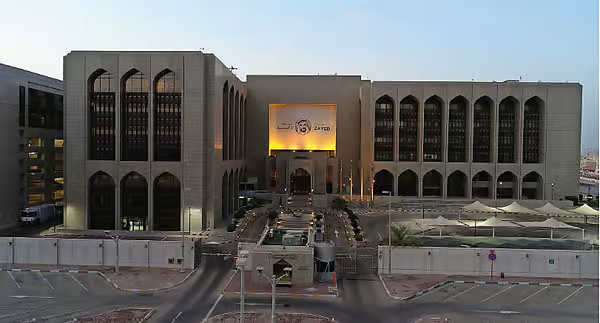
Chaired by H.H. Sheikh Mansour bin Zayed Al Nahyan, the CBUAE Board has approved the most comprehensive proactive banking resilience package in UAE history. Here is everything you need to know.
By ChainX Editorial Team | March 2026 | Reading Time: 12 Minutes | Category: UAE Banking & Real Estate Investment
The Central Bank of the UAE (CBUAE) has taken a landmark step in proactive financial governance. Chaired by H.H. Sheikh Mansour bin Zayed Al Nahyan, the CBUAE Board has approved a comprehensive financial institution resilience package backed by CBUAE assets of D1 trillion.
This is not a reaction to a crisis. It is a pre-emptive measure — a deliberate decision to reinforce the UAE’s financial architecture before any external pressure can find a weakness.
For property investors, mortgage holders, businesses, and tenants in the UAE, this decision has direct and meaningful implications. A central bank that acts from strength, with D1 trillion in assets behind it, is a central bank that protects the foundations your investment, your income, and your financial life are built on.
This article breaks down the full package: what it covers, what the numbers mean, why it was needed, and exactly what it means for Dubai real estate and the people invested in it.
Table of Contents
1. What Is the CBUAE Resilience Package?
2. The Financial Indicators Behind the Package
3. The Five Key Pillars: A Complete Breakdown
4. Pillar 1: Monetary Policy Measures
5. Pillar 2: Liquidity and Funding Relief
6. Pillar 3: Capital Buffer Relief
7. Pillar 4: Credit Risk Management
8. Pillar 5: Additional Support for the National Economy
9. Why This Package Was Needed in 2026
10. What It Means for UAE Banks
11. What It Means for Borrowers and Businesses
12. What It Means for Dubai Real Estate Investors
13. How the CBUAE Package Directly Impacts Dubai Real Estate
14. The CBUAE’s Track Record: Why It Matters
15. Conclusion: A Foundation Built to Hold
16. Frequently Asked Questions (FAQ)
1. What Is the CBUAE Resilience Package?
The CBUAE resilience package is a structured, multi-dimensional financial stability programme approved by the CBUAE Board and backed by D1 trillion in central bank assets.
Its purpose is straightforward: to ensure that UAE banks have the tools, flexibility, and capital access they need to continue supporting the economy regardless of what external conditions emerge.
The package is proactive by design. Rather than waiting for stress to build in the financial system and then intervening, the CBUAE has deployed this framework ahead of time. That distinction — prevention rather than cure — reflects a central banking philosophy that has consistently kept the UAE ahead of global financial shocks.
The package is structured around five key pillars, each targeting a specific dimension of banking resilience:
- Monetary policy flexibility and liquidity access
- Temporary relief on liquidity and stable funding ratios
- Release of countercyclical and conservation capital buffers
- Credit risk management flexibility for borrowers under stress
- An unconditional commitment to maintaining financing support for the national economy
This is not a rescue package. This is a resilience package. The CBUAE is not responding to a failure — it is engineering the conditions that prevent one from ever occurring.
2. The Financial Indicators Behind the Package
To understand the significance of this package, it is essential to see the financial strength it is built on. The CBUAE has published five headline metrics that define the current state of the UAE’s banking system.
Overall Liquidity: D920 Billion
The overall stock of liquidity in the UAE banking system is close to D920 billion. This represents the total available liquid assets across all UAE financial institutions — one of the deepest liquidity pools in the region and a direct measure of the system’s ability to meet obligations under any conditions.
Bank Reserve Balances: Exceed D400 Billion
Banks’ reserve balances exceed D400 billion. Reserve balances are the funds banks hold at the central bank — immediately accessible capital that serves as the first line of defence in any liquidity scenario.
Banking Sector Fundamentals: D5.4 Trillion
The UAE banking sector’s total fundamental asset base stands at D5.4 trillion. This is the full scale of UAE bank balance sheets — the total assets across all financial institutions operating in the country. A D5.4 trillion asset base places the UAE banking sector among the most substantial in the world relative to its economy.
Foreign Exchange Reserves: Exceed D1 Trillion
Foreign exchange reserves exceed D1 trillion. FX reserves are the CBUAE’s stockpile of foreign currencies and assets. They serve as a shield against currency volatility, external payment obligations, and imported financial shocks. At over D1 trillion, the UAE’s FX reserve position is one of the strongest in the world.
Monetary Base Cover Ratio: 119%
The monetary base cover ratio stands at 119%. This means the CBUAE holds liquid assets equivalent to 119% of the total monetary base — all the currency in circulation and bank reserves combined. A ratio above 100% is the benchmark for a fully backed monetary system. At 119%, the UAE exceeds that benchmark by a significant margin.
Key Takeaway: These five figures together describe a banking system that is not merely stable — it is deliberately over-capitalised, with multiple layers of redundancy built into its financial architecture.

3. The Five Key Pillars: A Complete Breakdown
The CBUAE package operates through five distinct pillars. Each targets a specific vulnerability in the banking ecosystem. Together they form an integrated resilience framework that covers monetary policy, liquidity, capital, credit, and operational support simultaneously.
4. Pillar 1: Monetary Policy Measures
What the CBUAE announced: Enhanced access to reserve balances up to 30% of the cash reserve requirement, and availability of term liquidity facilities in both D (UAE Dirham) and USD (US Dollar).
What This Means
Under normal conditions, banks can only access a limited portion of their reserve balances held at the CBUAE. This pillar increases that access threshold to 30% of the cash reserve requirement. In practical terms, this means banks can draw significantly more capital from their central bank reserves on short notice.
Combined with the availability of term liquidity facilities in both dirhams and US dollars, this gives UAE banks a dual-currency safety net that reflects the reality of how UAE businesses and international trade actually operate.
Why It Matters
The UAE financial system operates in both AED and USD simultaneously. Most major transactions, property deals, trade finance, and international investment flows involve both currencies. By providing liquidity facilities in both, the CBUAE ensures banks can meet obligations in either currency without having to convert under pressure.
5. Pillar 2: Liquidity and Funding Relief
What the CBUAE announced: Temporary relief in liquidity and stable funding ratios to provide banks with greater flexibility to support the UAE economy.
What This Means
Banks operating in the UAE are normally required to maintain strict liquidity ratios. These ratios define the minimum percentage of liquid assets a bank must hold relative to its liabilities. They exist to ensure banks can always meet short-term obligations.
Pillar 2 temporarily relaxes these ratio requirements. The capital that was previously locked up to meet ratio requirements can now be deployed into the economy as loans, facilities, and financing.
Why It Matters
In periods of uncertainty, banks naturally become more conservative — holding more capital than required and lending less. This behaviour can turn an economic slowdown into a credit crunch. By relaxing ratio requirements, the CBUAE removes the incentive for excessive caution and keeps credit flowing through the system.
When banks stop lending, economies stop growing. Pillar 2 is a direct intervention against that risk — ensuring that the UAE’s financial system keeps functioning regardless of what happens in global markets.
6. Pillar 3: Capital Buffer Relief
What the CBUAE announced: Temporary release of the Countercyclical Capital Buffer (CCyB) and Capital Conservation Buffer (CCB) to support the UAE economy.
What This Means
Capital buffers are additional reserves that banks must hold above their minimum capital requirements. They are built up during periods of economic growth and are designed to be released during downturns to absorb losses and maintain lending capacity.
The Countercyclical Capital Buffer (CCyB) is specifically designed to be built during boom periods and released during stress. The Capital Conservation Buffer (CCB) is a standard buffer all banks must hold to ensure capital is conserved during downturns. Releasing both simultaneously frees up significant additional capital across the UAE banking sector.
Why It Matters
Capital buffer release is one of the most powerful tools in a central bank’s toolkit. It directly increases the lending capacity of every bank in the system at once. The effect is amplified because banks can lend a multiple of their capital base — releasing even a modest amount of buffer capital can unlock significantly larger amounts of credit in the wider economy.
7. Pillar 4: Credit Risk Management
What the CBUAE announced: Providing flexibility to banks to postpone classification of individual and corporate loans for customers affected by the extraordinary circumstances.
What This Means
Under normal regulatory requirements, a bank must classify a loan as non-performing once a borrower misses payments beyond a defined threshold. Once classified as non-performing, a loan triggers a cascade of consequences: increased bank capital requirements, potential legal proceedings, and damage to the borrower’s credit standing.
Pillar 4 gives banks the discretion to delay this classification process for borrowers who are experiencing difficulty due to extraordinary external circumstances — not because of underlying financial weakness, but because of conditions beyond their control.
Who This Protects
- Individual mortgage holders — homeowners facing temporary income disruption who can continue servicing their mortgage with modest restructuring
- SME and corporate borrowers — businesses affected by external conditions who are fundamentally sound but facing short-term cash flow pressure
- Real estate developers — project sponsors managing delayed revenues or phased receivables during periods of market adjustment
Why It Matters
Premature loan classification is one of the most destructive forces in any financial system. When technically viable borrowers are reclassified as non-performing due to temporary conditions, it damages their credit permanently, forces banks to recognise unnecessary losses, and creates a self-fulfilling cycle of financial distress. Pillar 4 breaks that cycle before it starts.
8. Pillar 5: Additional Support for the National Economy
What the CBUAE announced: In view of the extraordinary circumstances, the CBUAE affirms that banks should continue to provide the required financing services to support their customers and the national economy.
What This Means
Pillar 5 is different in nature from the other four. It is not a technical regulatory measure — it is a direct instruction and commitment from the central bank to every financial institution operating in the UAE.
The message is unambiguous: keep lending. Keep supporting your customers. Keep the financing services of the national economy operational. The CBUAE has given banks the tools through Pillars 1 to 4. Pillar 5 is the mandate to use them.
Why It Matters
Central bank communication is a tool of economic policy in its own right. When the CBUAE makes an explicit public commitment to sustained financing support, it provides certainty to businesses, investors, and consumers. That certainty — the knowledge that the system will continue to function — is itself a stabilising force.
The five pillars work as a system, not as isolated measures. Together they increase liquidity, release capital, protect borrowers, and mandate continued support — addressing every dimension of potential stress simultaneously.
9. Why This Package Was Needed in 2026
Understanding why the CBUAE deployed this package requires understanding the global financial environment that the UAE is operating within.
Global Interest Rate Pressure
Major central banks in the US and Europe maintained elevated interest rates through 2024 and into 2025. While UAE rates are linked to the US Federal Reserve through the dirham peg, the CBUAE has tools to manage domestic financial conditions independently. This package is one of those tools.
Geopolitical and Trade Uncertainty
Global trade flows have been disrupted by a series of geopolitical developments since 2022. As a deeply trade-integrated economy, the UAE is exposed to these flows. The package ensures that any slowdown in trade activity does not translate into a domestic credit contraction.
Global Credit Market Conservatism
International banks and institutional lenders have become more conservative in their credit deployment globally. The CBUAE’s package ensures that domestic UAE banks compensate for any reduction in international credit availability by maintaining and expanding their own lending activity.
The Philosophy of Pre-emption
Most importantly, this package reflects the CBUAE’s established philosophy: act before the problem arrives, not after. This approach was validated in 2020 when the CBUAE’s early intervention during COVID-19 allowed Dubai to record its highest-ever property transaction volumes by 2021. The same logic applies here.
10. What It Means for UAE Banks
For financial institutions operating in the UAE, this package delivers four immediate operational benefits.
Increased Liquidity Access
Banks can now draw up to 30% of their cash reserve requirement from CBUAE reserves, and access term liquidity facilities in both dirhams and dollars. This dramatically increases the capital available to them on short notice, reducing any risk of liquidity stress.
Expanded Lending Capacity
With liquidity ratios temporarily relaxed and capital buffers released, UAE banks have significantly more capital available for deployment as loans and credit facilities. This is not theoretical capacity — it is immediately usable lending firepower.
Reduced Regulatory Pressure
The temporary relaxation of ratio requirements reduces the regulatory burden on banks during a period of uncertainty. Banks can focus on supporting customers and the economy rather than managing ratio compliance under stress conditions.
Credit Portfolio Protection
The credit classification flexibility of Pillar 4 protects bank loan portfolios from unnecessary deterioration. By allowing banks to manage temporary borrower stress without triggering automatic non-performing loan classifications, the package helps banks maintain healthier balance sheets.
11. What It Means for Borrowers and Businesses
For individual borrowers and businesses operating in the UAE, this package provides meaningful protection across three dimensions.
Mortgage Holders
Homeowners who face temporary income disruption are protected from automatic loan reclassification. Banks have the flexibility to restructure repayment schedules, extend grace periods, or defer classification decisions — preventing a temporary difficulty from becoming a permanent credit problem.
SMEs and Corporate Borrowers
Small and medium-sized businesses benefit directly from Pillars 2 and 4. The combination of expanded bank lending capacity and credit classification flexibility means SMEs can access funding and manage debt obligations with significantly more support from their banking partners.
Large Corporates and Developers
Real estate developers, infrastructure operators, and large corporate borrowers benefit from all five pillars simultaneously. The package ensures that major financing facilities remain available, project finance is not disrupted, and any temporary cash flow challenges can be managed constructively with their banks.
The message from the CBUAE to every bank in the UAE is clear: support your customers. The central bank has given you D1 trillion in assets, released your capital buffers, relaxed your ratios, and told you explicitly to keep lending.
12. What It Means for Dubai Real Estate Investors
For property investors — whether you are buying your first apartment, managing a portfolio of rental units, or evaluating an off-plan investment — this package has five direct implications.
Mortgage Availability Is Protected
The single biggest risk to any property market is a sudden contraction of mortgage credit. When banks stop lending to homebuyers, transaction volumes fall and prices follow. The CBUAE package is designed specifically to prevent that scenario. With banking liquidity reinforced and lending mandated by the central bank, mortgage availability in Dubai should remain healthy throughout any period of external pressure.
Developer Finance Stays Active
UAE property developers rely on bank financing to fund construction, manage working capital, and deliver off-plan projects on schedule. With capital buffers released and liquidity ratios eased, developer finance pipelines remain funded. This protects off-plan buyers from project delays caused by developer liquidity constraints.
Property Values Are Shielded from Credit Shock
Credit crunches destroy property markets. The historical record across every major global market is clear: when credit dries up, buyers disappear and prices collapse. The CBUAE package is a pre-emptive intervention against exactly that risk. By keeping credit available and flowing, it maintains the buyer activity that sustains Dubai’s property market.
Rental Demand Is Supported
A resilient banking system supports business activity. When businesses can access financing and continue to operate, they employ people. Employed people need somewhere to live. The CBUAE package is therefore as much a support for rental demand as it is a banking measure.
International Investor Confidence Is Reinforced
When international investors see a central bank that acts decisively, proactively, and from a position of D1 trillion in assets, they draw one conclusion: this is a market where the system works. That confidence drives capital flows. Capital flows drive property demand.
13. How the CBUAE Package Directly Impacts Dubai Real Estate
Dubai’s real estate market does not operate in isolation from its banking system. Every mortgage issued, every off-plan project financed, every developer credit facility arranged, and every commercial lease backed by a bank guarantee runs through the same financial infrastructure the CBUAE has just reinforced.
The Dubai Mortgage Market: More Capacity, Lower Risk
Mortgage lending in Dubai has grown substantially over the past three years. End-user buyers now account for a significant share of residential transactions. This shift has made Dubai’s market more structurally stable but also more dependent on consistent mortgage availability.
With Pillar 2 relaxing liquidity ratios and Pillar 3 releasing capital buffers, UAE banks have more deployable capital to extend as home loans. Pillar 1’s dual-currency liquidity access means banks can manage their AED and USD funding without restricting mortgage issuance. The result: mortgage availability in Dubai should remain deep and competitively priced regardless of external funding pressures.
The Off-Plan Market: Developer Finance Protected
Dubai’s off-plan sector accounts for the majority of real estate transactions by volume. Off-plan projects depend entirely on a functioning bank financing ecosystem — from the construction loans that fund building activity to the escrow accounts that protect buyer payments under UAE law.
The CBUAE’s package ensures that developer construction finance lines remain available and priced competitively. Pillar 4’s credit classification flexibility is particularly important for developers managing phased payment structures or temporary construction cost pressure. Rather than being forced into non-performing classification, developers can work constructively with their banks — protecting project delivery timelines and off-plan buyers.
The Rental Market: Business Continuity Drives Tenant Demand
Dubai’s rental market is fundamentally driven by employment. When businesses are operating, growing, and hiring they attract professionals who need to rent. When credit to businesses dries up, companies contract, relocations slow, and rental demand weakens.
Pillar 5’s direct mandate to banks to keep financing the economy is therefore a direct support mechanism for rental demand. When UAE banks continue lending to businesses, those businesses continue to hire and expand. Each professional who relocates to Dubai for a job becomes a tenant in Dubai’s residential market. For buy-to-let investors, consistent rental demand is the foundation of their entire investment thesis.
Commercial Real Estate: Office and Retail Demand Sustained
Dubai’s Grade A office market has experienced strong demand from international corporations establishing regional headquarters. This demand is directly linked to the UAE’s trade programme — every new economic partnership the UAE signs brings new businesses to Dubai, and those businesses need office space.
The CBUAE package ensures that corporate banking facilities — the credit lines, trade finance instruments, and operational banking that these businesses require — remain available and competitive. A business with strong banking support is a business more likely to expand its Dubai footprint, take on larger office space, and commit to longer lease terms.
Property Values: The CBUAE as a Price Stability Mechanism
Property values in any market are ultimately a function of the balance between supply and demand, mediated by credit availability. The CBUAE package addresses the credit side of that equation decisively — ensuring that credit remains available, affordable, and actively deployed into the economy.
In markets where central banks have failed to act, or acted too late, the impact on property has been severe and sustained. The United States in 2008, the United Kingdom in 2009, and multiple emerging markets during the 2022 rate shock all experienced significant property value corrections driven primarily by credit contraction. Dubai did not. The CBUAE’s proactive approach is a primary reason why.
Golden Visa Investors: Your Asset Is More Secure Than Ever
Investors who have purchased property above AED 2 million to qualify for the UAE Golden Visa are holding an asset that is now supported by multiple layers of protection: RERA’s regulatory framework, the escrow law protecting off-plan payments, RERA’s rental index protecting income streams, and now the CBUAE’s D1 trillion resilience package reinforcing the banking system that underpins the entire market.
For Golden Visa investors, this package is confirmation that their choice of market was correct. They are not just holding a property — they are holding an asset in a jurisdiction where the central bank, the regulatory framework, and the government are all aligned around the same objective: a stable, growing, internationally trusted real estate market.
The CBUAE’s package does not just protect the banking system. It protects every mortgage, every off-plan investment, every rental income stream, and every commercial lease agreement in Dubai.
What Real Estate Investors Should Do Right Now
The CBUAE package creates a window of strategic opportunity for property investors. Here is how to think about it:
- Review your mortgage options now. With banking liquidity reinforced and lending capacity expanded, this is an optimal time to explore mortgage pre-approval, refinancing existing facilities, or locking in competitive rates.
- Consider off-plan opportunities with confidence. Developer finance is protected and construction loan availability is reinforced. Off-plan buyers can proceed knowing project delivery timelines are supported by a fully funded banking ecosystem.
- Buy-to-let investors should hold. Business continuity mandated by the CBUAE means employment levels are protected. Protected employment means protected rental demand. Yields in Dubai’s residential market — already among the highest of any major global city — are supported by this framework.
- Use this as due diligence confirmation. If you have been evaluating Dubai real estate but waiting for macro confirmation, this package is that confirmation. A D1 trillion asset-backed banking resilience framework is one of the strongest signals a central bank can send to international investors.
- Speak to a specialist. At ChainX, we track both the macroeconomic framework and the specific property opportunities it creates. Our advisors can help you connect this regulatory picture to your individual investment strategy, budget, and goals.
14. The CBUAE’s Track Record: Why It Matters
The CBUAE’s current package does not exist in isolation. It is the latest chapter in a consistent story of proactive, effective financial governance that has defined UAE central banking for over fifteen years.
2008 to 2010: Building the Framework
The global financial crisis exposed serious vulnerabilities in the UAE’s banking system. Rather than simply recovering, the CBUAE used the crisis as a blueprint for reform. New liquidity requirements, capital buffers, and supervisory frameworks were introduced — the same frameworks that underpin the strength metrics the UAE reports today.
2020: COVID-19 Response
When COVID-19 hit in March 2020, the CBUAE launched its Targeted Economic Support Scheme (TESS) with Dh256 billion in support. The result: Dubai recorded its highest-ever real estate transaction volumes in 2021. A crisis that crippled property markets globally became an accelerant for Dubai’s market, directly because of how well the financial system was managed.
2022 to 2023: Global Rate Shock
As the US Federal Reserve raised interest rates at the fastest pace in decades, property markets in the UK, US, Canada, and Australia fell sharply. Dubai’s market continued to grow. The reason: Dubai’s property market is driven by cash buyers and genuine end-user demand, supported by a regulated banking system that did not extend itself during the low-rate years.
2026: Pre-emptive Resilience
The current package represents the most sophisticated deployment of proactive central banking the UAE has yet implemented. Deploying a five-pillar framework backed by D1 trillion in assets before any systemic stress materialises is not just good policy. It is the gold standard of modern central banking.
15. Conclusion: A Foundation Built to Hold
The CBUAE’s D1 trillion resilience package is a statement of strength, not a sign of stress. It is the act of a central bank that knows its numbers, understands the global environment, and has chosen to act from a position of overwhelming strength rather than waiting for circumstances to force its hand.
The financial foundations it reveals are extraordinary by any global standard: D920 billion in overall system liquidity, D400 billion in bank reserves, D5.4 trillion in banking sector fundamentals, D1 trillion in foreign exchange reserves, and a 119% monetary base cover ratio.
The five pillars it deploys are comprehensive, coherent, and mutually reinforcing: more liquidity access, relaxed ratio requirements, released capital buffers, protected borrowers, and an unconditional mandate to keep the economy financed.
For real estate investors in Dubai and across the UAE, the message is clear:
- The financial system supporting your mortgage is liquid and well-capitalised
- The banks financing your developer’s project have explicit central bank support
- Your credit standing is protected even in scenarios of temporary financial difficulty
- The central bank has publicly committed to maintaining financing support for the national economy
- The track record of this central bank in delivering on its commitments is proven across three major global crises
A market is only as strong as the financial system beneath it. In the UAE, that system is backed by D1 trillion, governed by world-class regulation, and led by a central bank with a consistent record of turning challenge into opportunity.
At ChainX, we track every development in the UAE’s economic and regulatory landscape because the foundations matter as much as the market itself. This package reinforces what the data has consistently shown: Dubai real estate is not just an attractive investment. It is a structurally protected one.
16. Frequently Asked Questions
What is the CBUAE resilience package?
It is a comprehensive, proactive financial stability framework approved by the CBUAE Board, backed by D1 trillion in central bank assets, structured around five pillars covering monetary policy, liquidity, capital buffers, credit management, and economy-wide financing support.
Who chairs the CBUAE?
The CBUAE Board is chaired by H.H. Sheikh Mansour bin Zayed Al Nahyan, Deputy Prime Minister of the UAE and Member of the Abu Dhabi Ruling Family.
What does the 119% monetary base cover ratio mean?
It means the CBUAE holds liquid assets equivalent to 119% of the total monetary base. A ratio above 100% indicates the system holds more liquid assets than are needed to back all money in circulation. At 119%, the UAE exceeds the standard benchmark by a significant margin.
Does this package affect mortgage availability in Dubai?
Yes, positively. By reinforcing bank liquidity and mandating continued financing support, the package ensures that mortgage lending capacity in Dubai remains strong. Homebuyers and investors should continue to find competitive financing options available through UAE banks.
What is the difference between the CCyB and the CCB?
The Countercyclical Capital Buffer (CCyB) is built up during economic booms and released during downturns to absorb losses. The Capital Conservation Buffer (CCB) is a standard buffer all banks must hold to ensure they conserve enough capital to continue operating during stress periods. Releasing both simultaneously provides the maximum possible increase in deployable lending capacity.
How does this relate to Dubai real estate investment?
A resilient, well-capitalised banking system directly supports property investment by maintaining mortgage availability, protecting developer finance, sustaining business activity that drives rental demand, and signalling international confidence in the UAE market.
Is this a sign that the UAE banking system is in trouble?
No. The package is explicitly proactive and pre-emptive — deployed from a position of strength, not in response to stress. The financial metrics published alongside the announcement (D920B liquidity, D400B reserves, 119% cover ratio) confirm that the UAE banking system is operating from an exceptionally strong base.
What is Chainex role in this?
Chainex is a Dubai-based real estate platform that combines property expertise with economic intelligence to help investors, buyers, and tenants make informed decisions in the UAE market. We track regulatory, monetary, and market developments to ensure our clients always have the full picture behind their property decisions.
Invest with Confidence in the World’s Most Resilient Property Market
Chainex connects you to Dubai real estate opportunities backed by the UAE’s world-class financial and regulatory ecosystem.