


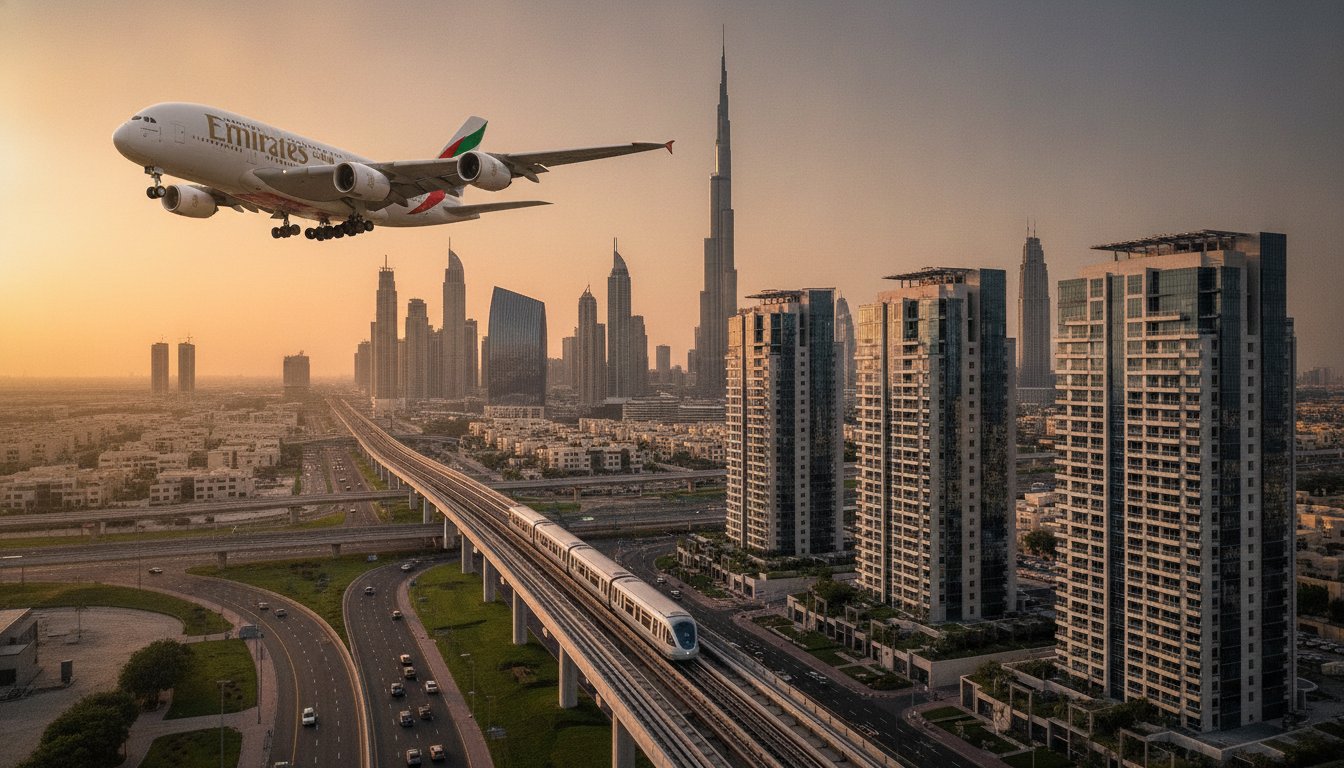
Did you know that the nation’s primary international airport is on track to handle a record number of passengers in 2026? This substantial figure isn’t just a milestone for aviation; it’s a fundamental indicator of how national infrastructure boosts property investment by consistently funneling international capital into the market. You likely understand that a property’s long-term value is tied to its accessibility, yet it’s natural to feel some uncertainty when trying to link these massive infrastructure trends to your personal ROI. Many investors worry about market liquidity or the risk of choosing areas that lack permanent transit support.
Identifying Transit-Oriented Developments (TOD) is the next layer of this strategic framework. These are areas specifically designed to leverage airline-related infrastructure, such as the expansion of the metro network or direct highway links to executive terminals. While proximity is vital, smart investors also evaluate the balance between accessibility and noise levels. Modern master-planned communities and projects like Vio Residences are now engineered with acoustic buffers and strategic flight path alignment to ensure that capital growth isn’t hampered by environmental factors. You’re looking for the intersection of logistical ease and residential tranquility, which often yields the highest long-term appreciation.
At Chainex Real Estate, we’ll show you how the unparalleled global reach of the national carrier serves as the primary engine for property value and investment security. You’ll discover the “Gateway Effect” on pricing and learn to identify high-growth corridors using the latest transit data. Our goal is to help you secure a real estate portfolio that remains resilient against global economic shifts. By examining the synergy between global connectivity and local demand, you can move beyond the surface of the market to find authentic, long-term stability for your assets.
Key Takeaways
- Understand the “Connectivity Premium” and why properties in regions with high global accessibility consistently command higher market prices and attract high-net-worth individuals.
- Analyze the ripple effect of a restored global network reaching 1,700 cities and how this massive scale provides a unique liquidity insurance for your real estate assets.
- Discover how Dubai’s infrastructure boosts property investment by positioning the city within an eight-hour flight of two-thirds of the world’s population, surpassing other global hubs.
- Learn to apply the “30-Minute Rule” to identify Transit-Oriented Developments that leverage airline-related infrastructure for superior long-term rental demand and value retention.
- Explore how a strategic partnership that integrates aviation and infrastructure data can help you navigate the 2026 market with precision and professional confidence.
The Strategic Link: How Global Hub Connectivity Drives Property Value
Real estate value in a globalized economy is increasingly defined by how quickly a location can be reached from the world’s major financial centers. This is the foundation of the “Connectivity Premium,” a measurable increase in property valuation for assets located within high-accessibility zones. In 2026, we’ve observed that investors aren’t just buying square footage; they’re purchasing proximity to the global network. This trend is a clear demonstration of how Dubai’s infrastructure boosts property investment, as the city’s status as a primary transit nexus ensures a constant influx of high-net-worth individuals who require a physical base for their global operations. When a city can handle 18.6 million passengers in a single quarter, as seen in early 2026, the demand for local assets naturally reaches a fever pitch.
The relationship between non-stop flight routes and international capital flow is direct and undeniable. Every new direct connection established by the national carrier acts as a fresh pipeline for investment. As the airline restores its reach to 137 destinations, it essentially expands the potential buyer pool for every villa and penthouse in the city. This global hub status creates a unique market environment where liquidity is guaranteed not just by local demand, but by a rotating audience of international wealth that arrives with every scheduled landing.
Understanding the Gateway Effect on National Assets
The national airline functions as a permanent, high-prestige marketing arm for the country’s real estate portfolio. Every business traveler who arrives for a summit or a board meeting is a potential investor in commercial properties for sale. We see a significant correlation between the frequency of these business arrivals and the absorption rates of premium office spaces and retail hubs. In this context, hub connectivity serves as a primary real estate liquidity metric, ensuring that assets can be traded or leased with far greater ease than in isolated markets.
Capital Mobility: From the Runway to the Residence
For international second-home owners, the psychological security of one-flight access is a decisive factor. Investors from the Americas, in particular, have shifted their focus toward the local market in 2026 following the expansion of long-haul direct routes. These buyers prioritize villas for sale that offer a seamless transition from the executive terminal to the front door. This level of capital mobility ensures that how Dubai’s infrastructure boosts property investment remains a central thesis for any sophisticated portfolio. The ability to move between continents with minimal friction transforms a property from a stationary asset into a flexible, global residence.
The 2026 Network: Reaching 1,700+ Cities and the Ripple Effect
By May 2026, the national carrier’s network restoration reached 96%, spanning 137 destinations across 72 countries. This massive operational scale serves as a permanent catalyst for the real estate market, providing over 1,300 weekly flight frequencies that act as a gateway for international capital. It’s essentially a constant open house for the nation’s properties. This massive reach is a primary factor in how Dubai’s infrastructure boosts property investment, as it brings a rotating audience of qualified buyers directly to the city’s doorstep every single hour. Every landing represents a potential new resident or investor looking to secure a stake in a high-growth environment.
The shift toward Partnership Connectivity has been equally transformative for the property sector. By linking the local market to 1,700 cities through strategic codeshare and interline agreements, the city has insulated its real estate sector from localized economic downturns. This broad reach is a cornerstone of the economic impact of aviation in Dubai, as it ensures that demand for assets remains globally diversified. When one region faces a slowdown, the network naturally pivots to attract capital from growth zones elsewhere, maintaining market liquidity and price stability across all property tiers.
Diversification of the Buyer Pool
The ability to reach 137 destinations directly has created a new class of “Weekend Residents.” These are professionals from regional hubs who use high-frequency flights to maintain a primary home in the city while working abroad. This trend has significantly increased the demand for luxury property dubai, as accessibility becomes just as important as the architectural design. If you’re looking for long-term stability, exploring dubai houses for sale in these well-connected corridors offers a clear path to value retention. This diversity in the buyer pool protects your investment from being tied to the fortunes of any single foreign economy.
Technological Edge: Connectivity in the Air and on the Ground
The introduction of Starlink-equipped aircraft has redefined the remote executive and digital nomad buyer segments. High-speed, low-latency Wi-Fi at 35,000 feet allows for real estate transactions to be reviewed and finalized mid-flight. This “Seamless Journey” philosophy ensures that the high-end rental market remains attractive to those who can’t afford to be offline. It turns travel time into productive time, further reinforcing how Dubai’s infrastructure boosts property investment by catering to the specific needs of the modern, mobile elite. This level of technological integration removes the traditional barriers to cross-border investing, making the national market more accessible than ever.
The Hub Advantage: Comparing Connectivity as a Real Estate Catalyst
When comparing global financial centers, the distinction between a traditional city and a global hub becomes clear through the lens of accessibility. While London and Singapore have long served as legacy anchors for capital, their geographic limitations often restrict their reach. The national model operates on a different scale. Being situated within an eight-hour flight of two-thirds of the world’s population provides a “centrality factor” that isolated markets simply cannot replicate. This geographic advantage is a core reason how Dubai’s infrastructure boosts property investment for those seeking a safe haven. It transforms the city into a bridge between East and West, ensuring that commercial properties for sale in aviation-led Free Zones like Dubai South remain in high demand by multinational corporations.
The resilience of this hub model was particularly evident during the market fluctuations of 2025. While other global cities saw a cooling of international interest due to localized economic shifts, the constant influx of travelers kept the local market liquid. This global hub status makes the nation a safer bet than markets that rely on a single domestic economy. The UAE’s aviation sector growth acts as a shield, maintaining property values through a diversified and rotating pool of international tenants and buyers.
Connectivity vs. Traditional Real Estate Fundamentals
In 2026, connectivity has often proven to be a more reliable predictor of property price surges than local GDP growth alone. When a region becomes more accessible, the velocity of capital increases. This “Resilience Factor” protected property values during recent global disruptions, as the hub could pivot to serve different emerging markets instantly. The following data highlights how connectivity correlates with market performance:
| Global Hub | Connectivity Score (2026) | Avg. Real Estate Appreciation |
|---|---|---|
| Dubai | 9.8 / 10 | High (8-12%) |
| Singapore | 9.2 / 10 | Moderate (4-6%) |
| London | 8.5 / 10 | Variable (2-5%) |
The Role of Partnerships in Market Stability
Strategic codeshare agreements and cargo expansions act as force multipliers for property visibility. When the national carrier expands its partnership network to 1,700 cities, it effectively places the city’s real estate portfolio in front of a global audience. We’ve also observed a direct link between increased cargo capacity and the demand for industrial real estate and commercial properties for rent. As logistics hubs expand to handle more freight, the surrounding residential areas see a corresponding rise in demand for townhouses for sale. As one industry expert noted in early 2026, “the shortest route to a high-yield investment is through a flight path.” This synergy between air traffic and land value is the cornerstone of a sophisticated investment strategy.
Investing Near the Hub: A Strategic Framework for Property Selection
Success in a globally connected market requires more than just picking a high-end neighborhood. It demands a sophisticated understanding of the “30-Minute Rule.” For the high-frequency traveler and the international executive, time is the most precious commodity. Properties located within a thirty-minute commute of the primary aviation hub consistently see higher occupancy rates and premium rental yields. This geographical prioritization is a prime example of how Dubai’s infrastructure boosts property investment by transforming transit time into tangible asset value. When you reduce the friction of travel, you increase the desirability of the residence for the world’s most mobile workforce.
Identifying Transit-Oriented Developments (TOD) is the next layer of this strategic framework. These are areas specifically designed to leverage airline-related infrastructure, such as the expansion of the metro network or direct highway links to executive terminals. While proximity is vital, smart investors also evaluate the balance between accessibility and noise levels. Modern master-planned communities are now engineered with acoustic buffers and strategic flight path alignment to ensure that capital growth isn’t hampered by environmental factors. You’re looking for the intersection of logistical ease and residential tranquility, which often yields the highest long-term appreciation.
Selection Criteria for Connectivity-Driven ROI
A macro-view of aviation is essential because the city’s growth follows its flight paths. If you’re considering buying property in dubai, your checklist should extend beyond the unit’s interior. Focus on these core metrics to ensure your asset remains competitive:
- Direct Hub Access: Can the location be reached within 20 to 30 minutes during peak hours?
- International School Corridors: Are the transit routes to top-tier schools aligned with the commute to the airport?
- Aerotropolis Integration: Is the property part of a long-term “airport city” plan that guarantees future infrastructure upgrades?
Predicting Future Gains via Route Announcements
The “First Mover” advantage in 2026 often belongs to those who track aviation data as a lead indicator. When the national carrier announces a major new direct route or the expansion of its A380 and 777X fleets, it signals a future influx of potential residents from those specific regions. This fleet expansion isn’t just about passenger capacity; it’s a statement of confidence in the market’s long-term scale and liquidity. To stay ahead of the curve, you should monitor official route map updates directly from the carrier’s newsroom or the Dubai Civil Aviation Authority. This data serves as a reliable preview of where the next residential “hot zone” will emerge. If you’re ready to align your portfolio with these global trends, explore our latest off-plan property sales in high-growth transit corridors.
Maximizing Your Portfolio with Chainex: Navigating a Connected Market
Chainex doesn’t just list properties; we provide a strategic lens for the global investor. We understand that a penthouse for sale in a prime district is more than a residence; it’s a node in a global network. By integrating real-time aviation data with urban planning insights, we help you understand how Dubai’s infrastructure boosts property investment at a granular level. Our consultants track everything from new terminal expansions to high-frequency flight paths, ensuring your portfolio is positioned for maximum liquidity and capital growth. We act as the bridge between visionary developers and international investors who require a sophisticated, data-driven approach to wealth preservation.
Our methodology is built on the pillars of professionalism and discretion. We recognize that the global traveler needs a partner who can manage the complexities of the local market while they’re in transit. Whether you’re interested in villas for sale or exploring commercial properties for rent, our team provides a seamless experience that mirrors the high standards of the national carrier’s executive service. We don’t just facilitate transactions; we build long-term partnerships that prioritize your security and comfort in a fast-moving economy.
The Chainex Advantage in a Globalized Economy
We’ve curated an exclusive selection of off-plan property sales that align with the 2026 connectivity corridors discussed in previous sections. Our deep relationships with developers allow us to secure units in upcoming Aerotropolis zones before they reach the general market. We guide our international clients through every step of the acquisition process, from calculating the 4% Dubai Land Department (DLD) transfer fee to navigating the AED 4,000 registration requirements for properties valued over AED 500,000. Our property management services ensure that your investment remains productive and well-maintained, even when you’re on the other side of the world. We look at the big picture of national growth to protect your assets against regional fluctuations.
Your Next Step in the Global Hub
Investing in a market this dynamic requires a bespoke strategy rather than a generic approach. We invite you to request a personalized market analysis that specifically considers your home country’s connectivity and flight frequency to the region. This tailored report will highlight high-growth corridors and transit-oriented developments that match your specific risk profile and ROI goals. Our commitment to high-prestige service means your affairs are handled with the utmost care and professional oversight. You can rely on our expertise to filter out the noise and focus on assets with genuine long-term value. Contact our advisors today to discuss our current listings, including townhouses for sale and apartments for rent, and secure your position in the world’s most connected market.
Securing Your Future in the World’s Most Connected Hub
The synergy between a world-class aviation network and a robust real estate market creates a unique environment for capital preservation. You’ve seen how the restoration of 96% of the global network directly translates into market liquidity and how the 30-Minute Rule serves as a vital filter for identifying high-yield assets. Understanding how Dubai’s infrastructure boosts property investment is the first step toward building a resilient portfolio in 2026. By focusing on transit-oriented developments and the Connectivity Premium, you’re positioning your assets at the heart of global capital flow.
Chainex offers a sophisticated approach to wealth management in this connected landscape. We provide specialized investment consulting based on macro-infrastructure data and exclusive access to prime off-plan units near major transit hubs. Our professional strategic partnership is designed for international HNWIs who require discretion and expert oversight. We invite you to explore high-yield property opportunities with Chainex Real Estate to align your assets with the city’s growth. Building a legacy in the world’s most accessible hub is a journey we’re ready to navigate with you.
Frequently Asked Questions
How does global airline connectivity affect property prices in the region?
Global connectivity creates a “Connectivity Premium” by ensuring a constant flow of international wealth into the local market. As more direct routes open, the pool of potential buyers expands, which naturally drives up demand for premium assets. This is a primary way how Dubai’s infrastructure boosts property investment, as it links physical real estate to the world’s most active capital corridors.
Is it a better investment to buy property closer to the international airport?
Properties within a 30-minute commute of the global hub typically offer superior rental yields and higher occupancy rates. These locations are highly sought after by international executives and frequent travelers who prioritize time efficiency. While proximity is a major driver, it’s essential to select master-planned communities that balance accessibility with high-quality acoustic infrastructure to ensure long-term residential appeal.
What is the 2026 outlook for the national aviation sector and real estate?
The 2026 outlook is exceptionally positive, with aviation traffic expected to reach record-breaking levels. This growth serves as a fundamental catalyst for the property market, providing a steady stream of new residents and investors. The expansion of the national fleet and network restoration ensures that the real estate sector remains a high-liquidity environment for both off-plan and ready properties.
How do airline partnerships with 1,700 cities increase real estate liquidity?
These partnerships act as a massive marketing engine, placing the city’s real estate portfolio in front of a global audience. By connecting to 1,700 cities, the market avoids over-reliance on any single foreign economy. This diversification means that if one region faces a slowdown, demand from other parts of the network keeps the property market liquid and resilient.
Can flight frequency data really predict future real estate ROI?
Flight frequency serves as a reliable leading indicator of where the next residential “hot zone” will emerge. An increase in direct flights from high-wealth regions is almost always followed by a surge in property inquiries from those specific areas. Savvy investors use this data to identify high-growth corridors before they reach peak market pricing, securing a first-mover advantage.
Why is the Global Hub model important for international property investors?
The Global Hub model provides a “Resilience Factor” that protects property values during global economic shifts. By functioning as a central nexus for two-thirds of the world’s population, the city maintains its status as a safe haven for capital. This model illustrates how Dubai’s infrastructure boosts property investment by offering a degree of stability that more isolated markets simply cannot match.
How does onboard connectivity influence the rental market for executives?
High-speed onboard connectivity, such as Starlink, allows executives to remain productive while in the air, making the city an ideal base for remote leadership. This seamless integration between travel and work drives demand for high-end apartments for rent in communities that offer similar technological infrastructure. It makes the transition from the executive lounge to the residence completely frictionless.
What are the risks of investing in areas with low air connectivity?
The main risk is reduced liquidity and slower capital appreciation compared to transit-oriented developments. Properties that are difficult to reach from the global hub often struggle to attract high-net-worth tenants or international buyers during market fluctuations. Without the support of world-class infrastructure, these assets may not offer the same level of protection against economic volatility.