


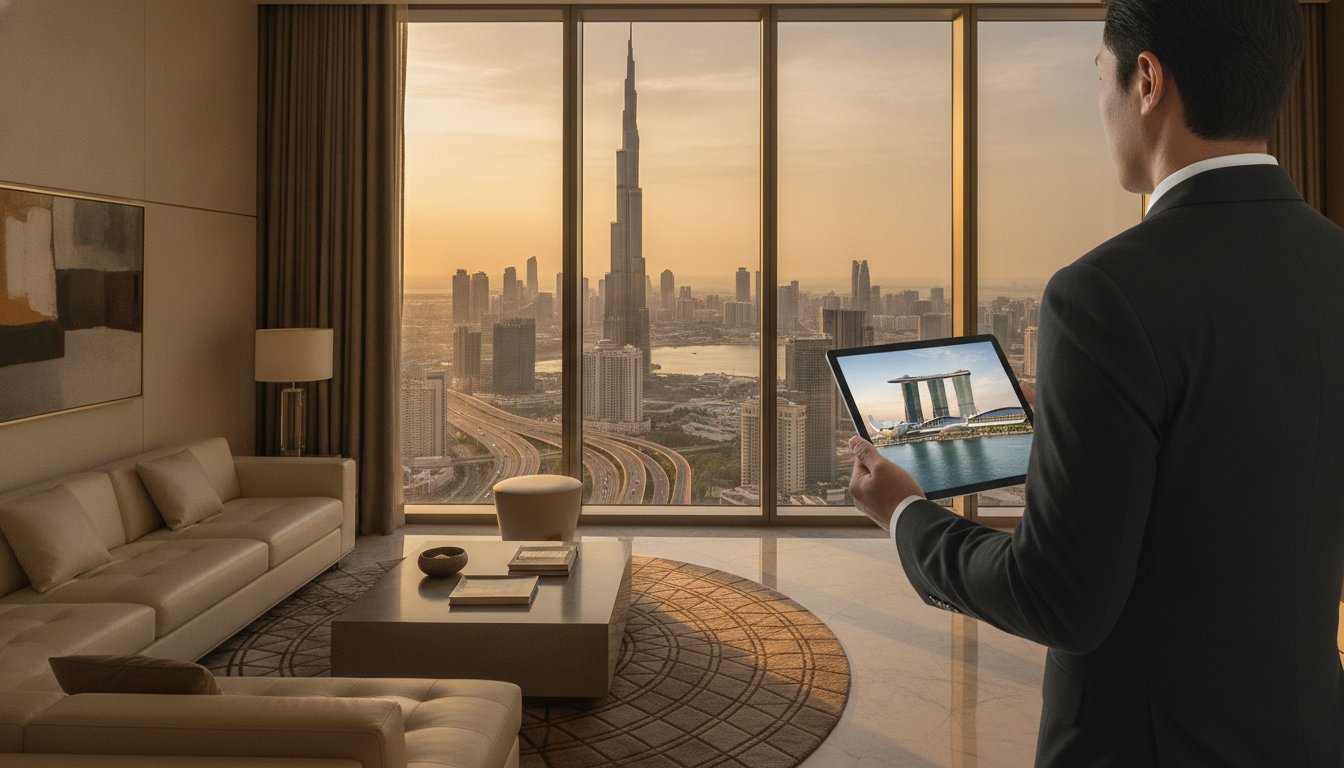
Can a 60% tax hurdle be the catalyst for a new era of global diversification? For many investors in Singapore, the Additional Buyer’s Stamp Duty has transformed the local residential market into a high-entry landscape where rental yields often hover between a modest 2% and 3%. This shift is prompting a strategic migration of capital From the Lion City to the Desert Skyline: Why Singapore’s Wealth Is Finding a Second Home in Dubai. While Singapore offers unparalleled stability, Dubai has emerged as the necessary high-yield counterpart, providing gross returns that frequently reach between 5% and 12% alongside a tax-neutral framework for rental income.
You probably recognize that true wealth management requires balancing the security of home with the growth potential of emerging global hubs. This guide explores why Singaporean investors are increasingly turning to the UAE to secure higher yields, tax efficiency, and lifestyle freedom in 2026. We’ll analyze the impact of the AED 2 million Golden Visa and the advantages of the existing Double Taxation Agreement. You’ll see how the 22% growth in Dubai’s transaction value during Q1 2026 signals a mature opportunity for your next strategic move.
Key Takeaways
- Understand the mechanics of achieving 5-12% gross rental yields in Dubai’s tax-neutral environment compared to the restrictive cooling measures currently impacting the Singaporean market.
- Explore why the scarcity of freehold landed property in the Lion City makes Dubai’s signature villas and ultra-luxury penthouses a more accessible and scalable choice for capital preservation.
- Learn how a strategic property investment of AED 2 million unlocks the 10-year UAE Golden Visa, offering your family enhanced global mobility and a secure secondary base.
- Discover why From the Lion City to the Desert Skyline: Why Singapore’s Wealth Is Finding a Second Home in Dubai has become the preferred diversification strategy for those seeking geopolitical neutrality.
- Identify how a professional partnership bridges the geographical gap, providing remote investors with essential local market intelligence and comprehensive property management services.
The Great Capital Migration: Why Singapore Investors are Targeting Dubai in 2026
The global map of wealth is being redrawn as sophisticated capital moves with surgical precision. For decades, Singapore stood as the primary sanctuary for Asian wealth, but the 2026 landscape shows a distinct pivot toward high-growth hubs that offer more than just preservation. Both Singapore and the UAE have mastered the art of geopolitical neutrality, creating a sense of security that few other regions can match. This strategic migration From the Lion City to the Desert Skyline: Why Singapore’s Wealth Is Finding a Second Home in Dubai represents a search for geographic diversification that hedges against regional concentration risks. It’s no longer just about a line on a balance sheet; it’s about a lifestyle integration where owners spend significant time in both global cities. The investment bridge between Singapore and Dubai is now solidified by a 22% growth in sales value recorded in Q1 2026, marking a record-breaking period for the Emirates.
The Push Factor: Singapore’s Cooling Measures
Local regulations have become increasingly restrictive for those looking to expand their residential portfolios. The 60% Additional Buyer’s Stamp Duty (ABSD) for foreigners and trusts creates a massive friction point for entry. Even for domestic high-net-worth individuals, the limited availability of freehold landed property in the Core Central Region makes it difficult to scale a portfolio effectively. Institutional capital led this charge toward the Middle East, seeking markets where entry costs don’t immediately erode the first five years of potential appreciation. For many, Singapore has become a market for capital preservation, while Dubai has taken the mantle of the growth engine.
The Pull Factor: Dubai’s Pro-Investor Ecosystem
Dubai offers a fiscal environment that feels almost revolutionary to those accustomed to high stamp duties. This growth is underpinned by a highly diversified economy that continues to attract global talent and tech firms. Individual investors benefit from several key structural advantages:
- Zero tax on capital gains and rental income for individual investors.
- A transparent framework managed by the Dubai Land Department (DLD) that ensures buyer protection.
- Strict escrow regulations that secure funds for off-plan property sales.
- Transaction speeds that often conclude within two to four weeks, compared to months in other jurisdictions.
While a property acquisition in Singapore involves lengthy legal cycles, Dubai’s streamlined process allows for transfers to be completed in a fraction of the time. The Dubai Land Department provides a transparent framework that protects buyers through digitized title deeds and real-time market data, ensuring that every transaction is handled with the highest level of professional integrity.

Yield and ROI: A Comparative Analysis of Two Real Estate Giants
The financial narrative of 2026 is defined by a search for superior returns that don’t compromise on security. While Singapore provides a rock-solid foundation for capital preservation, the rental yields in the Lion City have remained stubbornly low, often struggling to exceed 3% after accounting for taxes and maintenance. Contrast this with the UAE, where gross rental yields currently average approximately 6.68% as of May 2026. In some high-demand districts, these returns can climb as high as 12%. This stark difference explains the trend of capital moving From the Lion City to the Desert Skyline: Why Singapore’s Wealth Is Finding a Second Home in Dubai.
Investors also benefit from the currency peg. The UAE Dirham is pegged to the US Dollar, providing a layer of stability that’s particularly attractive to those managing global portfolios. It’s a strategic hedge that simplifies the repatriation of funds. As documented by Forbes, high-profile Singaporean investors seek Middle East opportunities to maximize their dollar-denominated assets in a market showing 6.09% annual price growth. This growth is especially pronounced in the villa segment, which saw nearly a 10% increase in value over the last year.
Rental Yields: Singapore’s 3% vs Dubai’s 7%+
For those prioritizing cash flow, the choice is increasingly clear. Dubai’s luxury segment, particularly in areas like Palm Jumeirah and Downtown Dubai, continues to see robust demand. In May 2026 alone, the market generated AED 28.51 billion across more than 10,000 deals. Short-term rental strategies can push net yields even higher than traditional long-term leases, especially during peak tourism seasons. To manage this from four thousand miles away, professional property management services are essential. They handle everything from tenant screening to maintenance, ensuring the distance doesn’t impact the quality of the investment. If you’re looking for consistent returns, exploring the current inventory of dubai houses for sale is a logical next step.
Tax Efficiency and Wealth Preservation
Wealth preservation in 2026 isn’t just about what you earn, but what you keep. Dubai remains one of the world’s most tax-efficient jurisdictions for real estate. There’s no income tax on rental returns and no capital gains tax for individual investors. This creates a powerful compounding effect over time. Moving capital between the two hubs is seamless, supported by a robust banking infrastructure. Many families are now using family offices or holding companies to structure their UAE holdings, ensuring a smooth transition of assets to the next generation without the burden of inheritance tax. This structural advantage is a cornerstone of why From the Lion City to the Desert Skyline: Why Singapore’s Wealth Is Finding a Second Home in Dubai has become a permanent fixture in modern wealth management.
From Good Class Bungalows to Ultra-Luxury Villas: Matching Property Types
The transition From the Lion City to the Desert Skyline: Why Singapore’s Wealth Is Finding a Second Home in Dubai is often sparked by the desire for tangible, landed assets. In Singapore, the Good Class Bungalow (GCB) is the ultimate status symbol, yet its acquisition is strictly limited to citizens and subject to extreme scarcity. Dubai’s villa market offers a compelling alternative, where international investors can secure freehold ownership of sprawling estates in prestigious enclaves like Palm Jumeirah or Emirates Hills. These properties don’t just match the prestige of a GCB; they often exceed them in terms of modern architectural freedom and private waterfront access. For many, the ability to own land outright in a global hub is the deciding factor that shifts capital toward the Emirates.
Vertical luxury also takes on a different dimension here. While Singapore’s luxury condos are world-class, Dubai’s penthouses frequently feature amenities that are rare in the Lion City, such as private sky-pools, dedicated elevator lobbies, and full-floor layouts that span over 10,000 square feet. The rise of branded residences, featuring names like Armani, Bulgari, or Ritz-Carlton, provides a familiar comfort level for Singaporean investors who value the marriage of real estate and elite hospitality services. These developments offer a level of service and exclusivity that mirrors the private club culture prevalent in Southeast Asia, making the move feel like a natural extension of one’s lifestyle.
Luxury Villas and Townhouses: The New Family Standard
Space and privacy are the primary drivers for families relocating or diversifying. In many of Dubai’s gated communities, the lifestyle infrastructure includes championship golf courses, international schools, and sophisticated wellness centers within walking distance. While a luxury condo in Singapore’s District 10 offers urban convenience, it cannot compete with the sheer volume of space found in the desert. A prime six-bedroom villa in Dubai’s Emirates Hills often provides three times the square footage of a luxury penthouse in Singapore’s District 9 for a comparable capital outlay.
Off-Plan Opportunities: Securing the Future
The off-plan market has become a cornerstone of the 2026 investment landscape, accounting for over 67% of all transactions in Q1 2026. Singaporean buyers, traditionally cautious, are increasingly comfortable with off-plan property sales due to the stringent protections enforced by the Dubai Land Department. Every dirham paid toward an off-plan unit must be deposited into a project-specific escrow account, which is only released to the developer as construction milestones are verified. This level of accountability, combined with staged payment plans that often stretch beyond the handover date, allows investors to leverage their capital without an immediate 100% outlay. It’s a strategic way to participate in the growth of the From the Lion City to the Desert Skyline: Why Singapore’s Wealth Is Finding a Second Home in Dubai narrative while maintaining liquidity for other ventures.
Strategic Residency: The Golden Visa and Global Mobility
Relocating capital is a significant financial decision, but securing a secondary base for one’s family is a strategic life move. The migration From the Lion City to the Desert Skyline: Why Singapore’s Wealth Is Finding a Second Home in Dubai is fundamentally rooted in the pursuit of long-term security. In 2026, the UAE’s Golden Visa stands as one of the most prestigious and accessible residency programs for high-net-worth individuals. By investing a minimum of AED 2 million in real estate, you unlock a 10-year renewable residency that serves as a vital safety net. This second home provides a robust hedge against regional shifts while offering a tax-neutral environment for global business operations. To understand the step-by-step process of securing such an asset, you can refer to our guide on How to Buy Property in Dubai: The Ultimate Guide for Investors (2026).
Property ownership in Dubai often acts as the catalyst for broader business synergy. Many Singaporean entrepreneurs use their residential base to establish a corporate presence in the UAE, taking advantage of the country’s strategic location between Europe and Asia. The ability to manage a global portfolio from a tax-efficient hub while maintaining the stability of a second residency is a priority for those navigating the complexities of the 2026 financial landscape.
The Path to Long-Term Residency
The AED 2 million investment threshold is designed with flexibility in mind, allowing investors to qualify through ready properties or off-plan projects. Once the residency is granted, you can sponsor your spouse and children, ensuring your family’s future is secure. A unique benefit of the Golden Visa is the absence of a minimum stay requirement; you don’t need to be physically present in the UAE every six months to keep the visa active. This flexibility is a key driver of why From the Lion City to the Desert Skyline: Why Singapore’s Wealth Is Finding a Second Home in Dubai has become such a prominent narrative for the modern global citizen.
Comparing Global Mobility: Singapore Passport + UAE Residency
Pairing a Singapore passport with a UAE residency card creates an unparalleled combination for international travel and business. You gain seamless access to two of the world’s most efficient aviation hubs, making the commute between Changi and DXB effortless. Families often find that Dubai’s social infrastructure matches the high standards of the Lion City. The city’s private healthcare facilities are world-class, and the international schools offer curricula that ensure a smooth transition for children. This high level of lifestyle parity makes the UAE an obvious choice for those seeking a familiar yet high-growth environment. If you’re considering a move to secure your family’s future, our current listings of Villas for Sale provide the perfect starting point for your search.
Navigating the Transition: Why a Strategic Partner Matters
Managing a real estate portfolio across six time zones requires more than just a digital connection. It demands a boots-on-the-ground presence that understands the pulse of the market in real time. For the sophisticated investor, the journey From the Lion City to the Desert Skyline: Why Singapore’s Wealth Is Finding a Second Home in Dubai isn’t merely a transaction; it’s a long-term strategic alignment. While the macro-economic benefits of the UAE are clear, the micro-market nuances—such as which specific plot in a new development will yield the highest capital appreciation—require local intelligence that generic online reports cannot provide. Chainex Real Estate acts as this vital bridge, translating the complex 2026 regulatory environment into actionable insights for Asian investors.
A professional partnership moves the conversation beyond simple acquisition toward comprehensive portfolio management. This includes navigating the mandatory fees involved in the process, such as the title deed issuance fee of AED 250 or the trustee fees that typically range between AED 4,000 and AED 5,000 plus VAT. To explore the highest tier of available assets, our The Definitive Guide to Luxury Property in Dubai (2026) provides a curated look at the most exclusive opportunities currently defining the market.
Tailored Consulting for Singaporean Clients
Singaporean HNWIs operate with a mindset defined by precision, discretion, and a deep respect for regulatory compliance. We tailor our consulting services to match this expectation, providing detailed market analysis that identifies high-growth corridors before they reach their peak. This involves understanding the specific reporting needs of our clients and ensuring that every investment aligns with their broader wealth preservation goals. Our team provides a calm, supportive environment where you can evaluate the 6.09% annual price growth trends without the pressure of aggressive sales tactics. We focus on the data, such as the 12.22% year-on-year increase in off-plan home prices, to ensure your capital is positioned for maximum efficiency.
Maximizing Your Portfolio with Chainex
Our commitment to your success extends far beyond the initial search. We manage the entire end-to-step process, from identifying prime Off-plan Property Sales to securing the keys for your new residence. For those who choose to remain in Singapore, our Property Management Services ensure your investment is maintained to the highest standards, with tenants vetted and yields optimized without your direct intervention. We help you weigh the benefits of the secondary market against the potential of new launches, ensuring the choice matches your specific liquidity and growth targets. Contact us today for a bespoke investment briefing and discover how we can facilitate your transition From the Lion City to the Desert Skyline: Why Singapore’s Wealth Is Finding a Second Home in Dubai.
Securing Your Global Portfolio in 2026
The evolution of global wealth management is no longer a theoretical shift; it’s a practical reality for those seeking to hedge against regional cooling measures. By prioritizing tax-efficient yields and the security of the Golden Visa, you’re choosing a path that balances capital preservation with exceptional growth. The transition From the Lion City to the Desert Skyline: Why Singapore’s Wealth Is Finding a Second Home in Dubai represents a sophisticated move toward a market that rewards strategic diversification.
Achieving these results requires a partner who understands the high standards of the Singaporean mindset. Chainex Real Estate acts as a strategic partner to top UAE developers, offering expert investment consulting and comprehensive property management for overseas owners. We ensure your transition is discreet, professional, and optimized for long-term success. Our team handles the complexities of the local landscape so you can focus on the rewards of your international assets.
Explore Exclusive Dubai Houses for Sale with Chainex Real Estate and begin your next chapter in a city designed for the global elite.
Frequently Asked Questions
Is Dubai real estate as stable as Singapore’s market for long-term investment?
Dubai’s market has reached a mature phase in 2026, offering a different type of stability focused on sustained growth and high demand. While Singapore remains a benchmark for low-risk capital preservation, Dubai provides a mature environment where the residential price index grew by 6.09% year-on-year. It’s best viewed as a high-performance engine that complements the foundational stability of a Singaporean portfolio, offering a hedge through geographic and currency diversification.
Can Singaporean citizens own freehold property in Dubai?
Yes, Singaporean citizens have the right to 100% freehold ownership in designated investment zones across the emirate. This legal framework grants you full rights over both the building and the land it stands on, with no restrictions on resale or inheritance. This is particularly attractive for those who find the scarcity of freehold landed property in the Lion City a barrier to scaling their residential holdings effectively.
How do rental yields in Dubai compare to Singapore’s CCR (Core Central Region)?
Dubai’s gross rental yields currently range from 5% to 12%, which is substantially higher than the 2% to 4% typically seen in Singapore’s CCR. This significant yield gap is a primary driver for the migration of capital From the Lion City to the Desert Skyline: Why Singapore’s Wealth Is Finding a Second Home in Dubai. When you factor in the absence of tax on rental income, the net returns in the UAE become even more compelling.
What are the tax implications for a Singaporean resident owning property in Dubai?
Individual investors in Dubai currently pay zero tax on rental income and capital gains. Under the existing Double Taxation Agreement between the UAE and Singapore, income that’s taxed in the UAE, even at a zero percent rate, may be exempt from further taxation in Singapore. This fiscal efficiency allows for the rapid compounding of wealth, as you aren’t losing a significant portion of your returns to annual income levies or stamp duties.
How does the Golden Visa work for real estate investors in 2026?
The 10-year Golden Visa is available to any investor who secures property with a minimum value of AED 2 million. This residency is renewable and doesn’t require you to reside in the UAE for a minimum number of days each year. It provides a secure secondary base for your family and allows you to sponsor spouses and children, ensuring your global mobility is protected regardless of regional shifts.
Is it possible to manage a Dubai property while living in Singapore?
Remote management is highly efficient thanks to Dubai’s digitized real estate infrastructure and professional property management firms. These services handle everything from finding high-quality tenants to managing day-to-step maintenance and legal compliance. You can track your investment’s performance and manage title deeds through official government apps, ensuring your asset remains productive while you focus on your business or family life in Singapore.
What are the main differences in the buying process between Singapore and Dubai?
The transaction speed in Dubai is one of its most distinct advantages, with many deals closing within two to four weeks. Instead of the high stamp duties found in Singapore, Dubai buyers pay a one-time 4% fee to the Dubai Land Department. The process is streamlined and transparent, with all off-plan payments protected by government-regulated escrow accounts, ensuring a level of security that matches the highest international standards.
Are there any restrictions on repatriating rental income from Dubai to Singapore?
There are absolutely no restrictions or capital controls on moving funds out of the UAE. Since the UAE Dirham is pegged to the US Dollar, you benefit from currency stability when transferring your rental income or sales proceeds back to Singapore. This ease of movement ensures that your UAE assets remain a liquid and integrated part of your global wealth, accessible whenever your strategic needs change.
